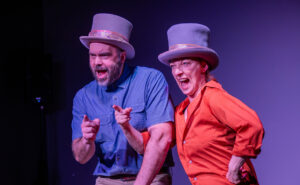
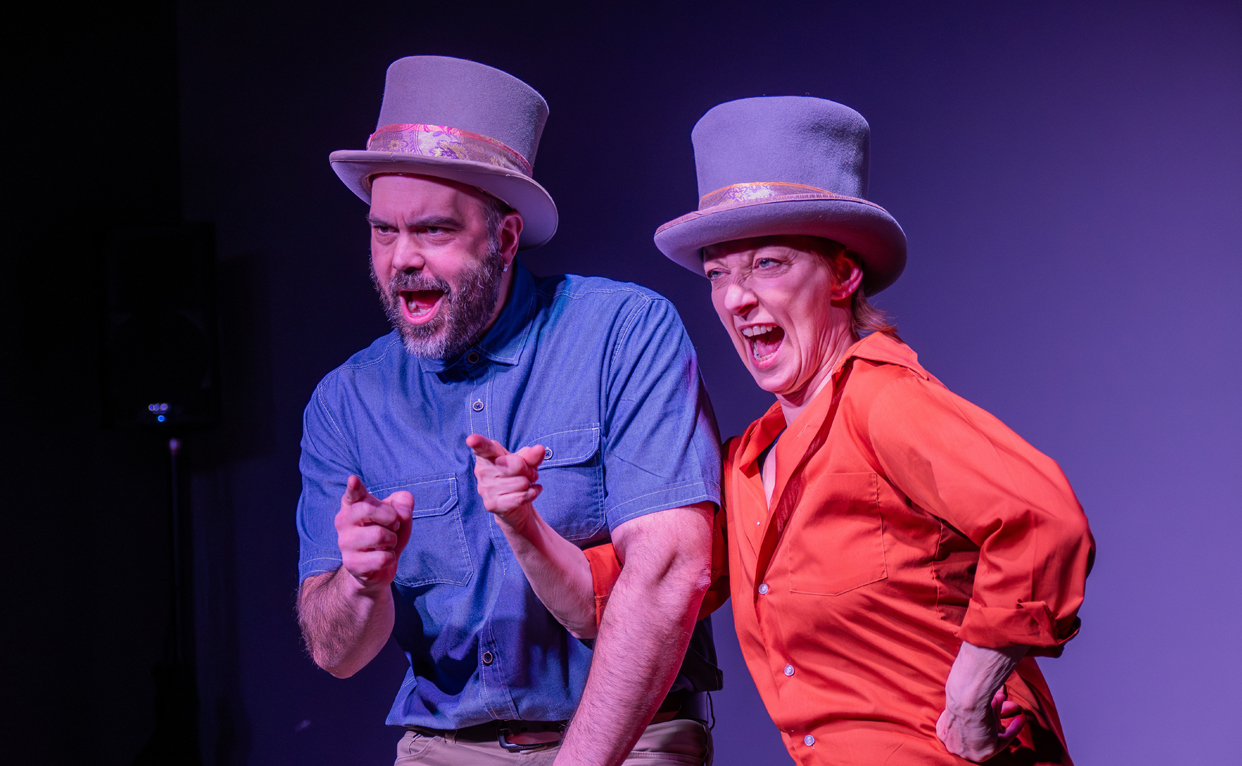
Sébastien Labelle and Marie-Josée Chartier in Fracas Photo by Rebecca Driedger
There is a new partnership between Mayworks Kjipuktuk and Eastern Front Theatre– Stageworks is bringing three works of theatre and visual arts to audiences in Halifax this fall and winter. The first is Fracas, a new play by Margaret Sweatman directed by Arne MacPherson, which will be at the Bus Stop Theatre November 19th-21st, 2026. I had a chat with the two actors in the show Marie-Josée Chartier and Sébastien Labelle via Zoom about bringing this work, which began in Winnipeg, to Halifax, and this new union between Mayworks and Eastern Front.
The play is being described my the creative team thus, “In the moments after death, the psyche of one person splits into two entities: Bardom and Ziggy. These alter egos are in limbo, the waiting room after death, where the monsters of contemporary life swirl through an overly receptive imagination. Fracas is a play about all of us: tragic comic failings, vivid with love and resistance.” “It’s a play that examines a lot of the shared anxieties we have right now about the state of our world and our place in it,” Labelle says.
It was written by Margaret Sweatman, who is also a novelist. She has written six novels, and has one forthcoming called Night Birds. Her novels have won the McNally Robinson and the Margaret Laurence Awards. “She has quite a complex brain,” says Chartier. “In my exchanges with her over the years through email she has an incredible sense of humour. She has a very, sharp, sharp wit. Her books are very political- she does a lot of research, and they all address some kind of social issues… And she’s very playful. She loves to laugh. She has a really wild imagination.”
This is all characteristic of the play as well. Chartier says, “Because of the title Fracas, it has this fracasser- something kind of burst into pieces- and because we are one cell that splits in half in the moments right after death, in that very short amount of time we are literally bombarded by memories- the anxieties, our personal lives, and things we remember. So, sometimes we’re inhabited by these memories, we become the spokesperson for an environmental song, and then we’re suddenly at a Republican convention, we’re suddenly a folk couple dancing, singing a song about ‘money is white’, so there’s almost a dark side, I would say, in everything, but we bring it, a lot of times, with humour- knowing that the point of the anxiety and the darkness can go across without having to hit people over the head.” She says that Sweatman wrote the play in 2018, and that the big themes of dramatic current events- fires, floors, plagues- have only become more relevant. “It’s very fragmented. It’s a quick pace.” She says that although she and Labelle are the same person they sometimes have different memories from their life. “We have those two sides of one personality,” she says.
“Fracas is a French word that’s borrowed into English because there’s no real equivalent in the English language for what it means, which is the sound of something shattering, or broken apart,” says Labelle. “I think for a lot of people we feel like that’s what’s happening to our world right now. And, for a lot of us, it’s what we feel like is happening to our lives right now. The play addresses that, but also because it’s theatre, it allows audiences to come together to experience this, and come out of this sense of isolation and kind of commune together through this theatrical experience and feel like ‘Yeah. I feel that. Do you feel that? Yeah. We all feel like that. Okay, this is normal to feel like this because this is real.’ So the play does give that kind of cathartic experience of knowing that we’re normal to feel these anxieties because they’re shared. In a kind of counterbalance to the thematics of being broken apart and shattered, the theatre brings audiences together to come and reflect on a lot of the questions that are being raised through the play… There’s a lot of talk [in the world] about how our communities are fragmented, and our social networks are fragmented because of social media, and our dependence on digital communication, which has kind of usurped our face to face communication. So, I think the power of live art is an antidote to that, and the simple act of going out to experience theatre is a pushback against that sense of isolation and fragmentation.”
“There’s so many layers. There’s the social layer, there’s the political layer, there’s the personal layer. There’s also a big layer about the artistic life of someone- invent or die- my voice, my dances, my writing: does it matter? Two thirds into the play we start to kind of go down into the dark stuff. What do I do here? Does it matter? Will it ever make a difference? So, that’s written by a writer, and performed by actor dancers it’s like, yeah, every day we have to kind of reinvent and we have to make stuff up to just keep going. There’s also another layer of the minority language. There’s a whole French minority language that comes in and out throughout the play. In our case French is a minority language where we live, even my parents’ generation in Montréal where they couldn’t get a job if they didn’t speak English, but there’s also different languages in the play- speaking about other minority languages,” says Chartier. She says that when they did the show in Winnipeg a Brazilian dancer was moved by the piece because she said that she was really missing speaking her own language while in Canada. “It was nice to see that it reached out also to different cultures.”
Labelle says that that was one of his arguments when he was presenting to the Law Amendments Committee when Nova Scotia cut funding to the arts, “If you’re cutting funding to the arts and culture [sector], then as a Francophone, for my children when they leave the classroom their only access to French language is through Francophone arts and culture. If that’s not supported than its a direct blow to the sustainability of Francophone culture in Nova Scotia.” He says that while this isn’t a central theme in the piece, and the playwright isn’t Francophone herself, having both the actors being Francophones informed the writing. “The experience of Fancophones in minority language kind of serves as a template for any kind of linguistic or cultural minority being confronted with this kind of dominant culture that kind of washes out any difference, essentially,” he says. “And this quest for identity in this world.”
Chartier says that the French element in the play came about early in the development because the whole team, originally, was from Winnipeg, and then Margaret Sweatman saw Chartier performing in a dance show. “I think for her me being really deeply Francophone kind of really inspired her,” she says. Two of the original members were also Franco-Manitoban, so from the beginning that was going to be a core element in the show.
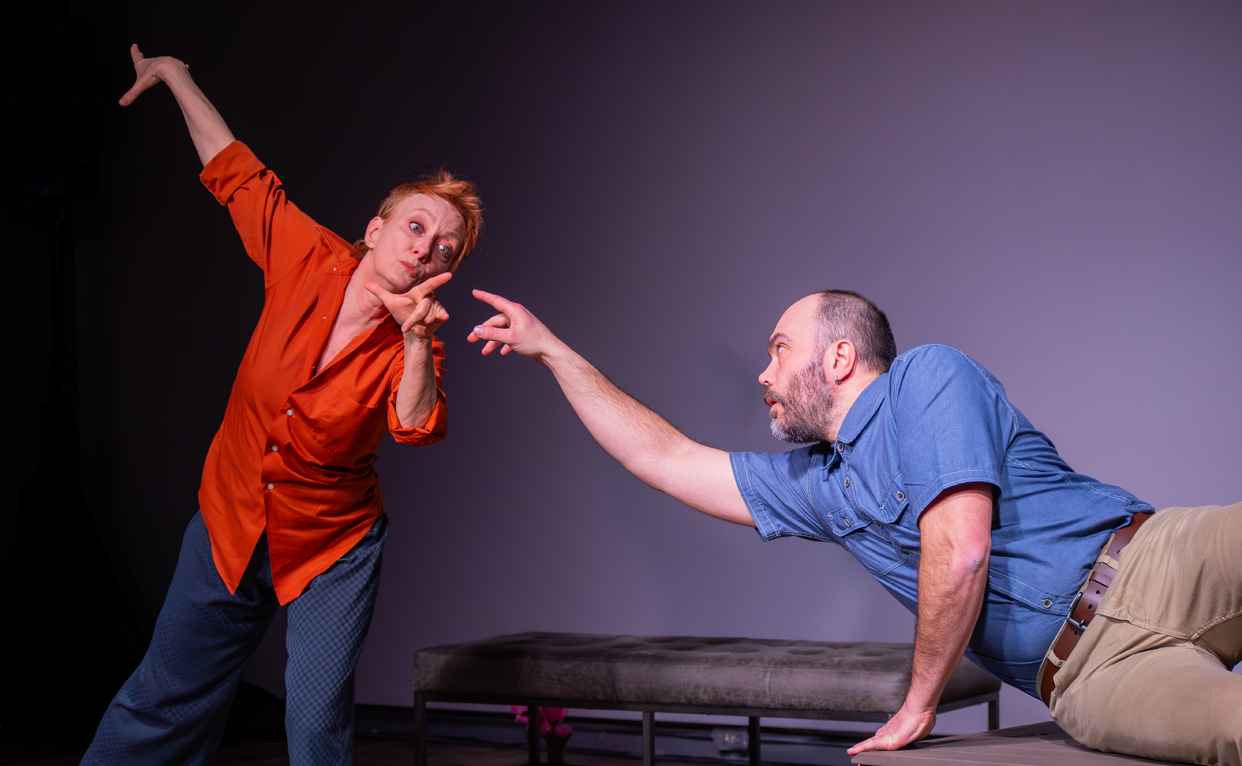
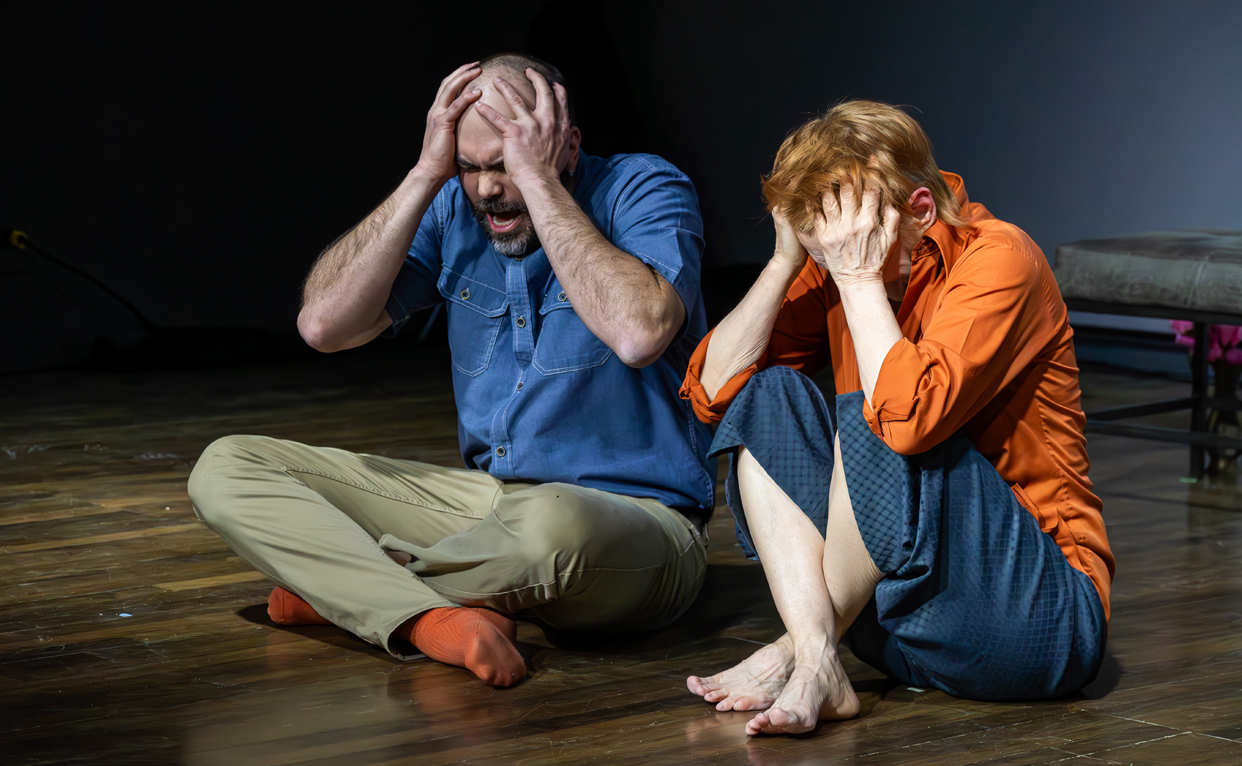
Sébastien Labelle knew Chartier because he had been cast in her dance piece Petites Danses, which was presented here by Mocean Dance back in 2021. “It kind of squeaked in between two pandemic waves, and we got to do a short run at Alderney Landing. That was my introduction to performing in dance, and also [how I met] Marie-Josée, who later reached out to me to revive this project.” He says that since they had started Fracas in 2018, of course its development had been impacted by the pandemic as well with many starts and stops in the process. “It made for a really interesting pan-Canadian project by having artists from Winnipeg, Toronto, and Halifax work together collaboratively. So, that was a lot of fun. It was a really great experience for me.” He says that having artists from different places in Canada has a meta-connection to the themes of the play, and this idea of a coming together as opposed to a breaking apart.
Labelle says that the style has been informed by the Surrealist and Absurdist movements of the early 20th Century and both during and after the Second World War in particular. “Those movements arose out of a time where the world didn’t seem to make sense anymore, and we find ourselves in a time where the world feels that way again. So, those storytelling styles that challenge the very nature of meaning feel relevant today when we’re really feeling like we’re grasping to make sense of the world we live in, and each of our own personal lives.”
For Chartier, a dancer and choreographer, Fracas is very text-based compared to other pieces she has worked on- although she says there’s a lot of songs, humour, clown, bouffon, and a lot of physicality in it, but it’s still very grounded in the script. “We don’t stop for 55 minutes,” she says laughing. “There’s one moment we stop, but not for very long”- a moment that she says honours Waiting for Godot, and has been described as “Beckett on crack.” “It’s very physical, it’s very musical, it’s very vocal, and it’s very, very dense.”
“It’s a text that is nonlinear. It does not fit the kind of conventions that we’ve been used to through kitchen sink realism- it’s a very different mode of theatre. You kind of have to come at it with an open mind, and look at the different pieces, and then ask yourself how they fit together, and what they culminate to. It doesn’t resolve in an easy cherry on top or tying the bow kind of ending- it does have an open ending that is left to audiences to ponder on, and come to their own conclusions about it, which I think is what makes it really interesting,” Labelle says.
Chartier says a lot of people who have seen the piece say that they want to come back and see it again. “There’s a lot of information.” She says that folks from different disciplines often have a different reaction to the work too. Those who come from dance or more physical art forms might be less focused on finding the meaning than those who come from more linguistic or literary backgrounds. “It’s a good idea to let go from the beginning, to be in- we’re trying to be in the moment all the time. It’s the kind of play that we’re still discovering things- five o’clock before opening in Toronto we had a light bulb about a moment- there’s layers of existentialism. So, there’s still things we’re discovering, and I think for the audience, some people came back twice because at first they’re just looking at everything, and there’s just a lot to digest,” she says. “It’s a very dreamlike experience or structure where as you’re going through a dream things shift kind of in a repeated non sequitur kind of way that you jump from one day to the next, and you’re just kind of being carried by the dream. It’s only after that you have the ability to reflect on what the meaning was of all it,” Labelle adds.
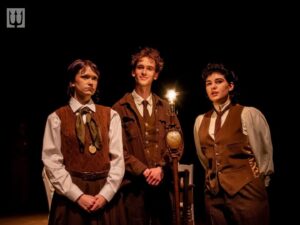
The piece is directed by Arne MacPherson, who has been with the piece from the start as well, and who Chartier characterizes as a “brilliant actor and great stage director.” He was born in Saskatchewan, raised in Edmonton, and is now based in Winnipeg. He works a lot in experimental and collaborative work like this, but also has experience working with the Deaf and disabled performance community through his work with sick + twisted theatre in Winnipeg.
The new partnership between Mayworks and Eastern Front Theatre came out of a desire from Labelle to collaborate more closely with Eastern Front Theatre’s Artistic Director Kat McCormack. The two companies worked together to present Zuppa’s The Movements between their two festivals back in 2023. Labelle also really wanted to see a remount of Alex McLean’s production of A Timed Speed-Read of the Triangle Shirtwaist Factory Fire Trial Transcript, which Mayworks had presented back in 2019. “In 2019 Mayworks was still pretty small,” he says. “I never felt like we got the audiences out that the shows deserved.” When he asked McCormack why she didn’t ever program the show at Stages she pointed out the conflict of being the curator of the festival and acting in the show at the same time, and also how the time commitment required for both also made it unfeasible. Labelle realized when working on Fracas he would have the same challenges ever presenting it at Mayworks, so it made sense to bring both these shows into the conversations he and McCormack had been having about collaborating during the offseason. He had also had a submission from Zachary Gough, a visual artist in New Brunswick, that, according to the press release, “explores the dysfunction of a housing system that conflates Housing as a human right with Housing as financial asset.” “Part of the challenge of putting on that show is that there’s an installation that is part of the show which is the actual life-size corner of a house that’s built to code, and so it requires a very tall space to be able to show it. The rotunda at Alderney Landing has a super high ceiling, and would fit that, so in the spirit of Mayworks as a multidisciplinary festival, in addition to having these two works of theatre presented as part of Stageworks, we also have Zach’s visual art exhibit in the lobby of Alderney Landing while the Triangle show is on,” he says.
Fracas produced by Chartier Dance plays November 19th and 20th, 2026 at 7:30pm, and November 21st at 8:00pm at The Bus Stop Theatre (2203 Gottingen Street, Halifax). Tickets range in price from $15.00 to $35.00 (you choose the price range best suited to you). Tickets are available online here or at the door at the Bus Stop Theatre before the performance. The run time of the show is 55 minutes. Get tickets to both Fracas AND A Timed Speed-Read of the Triangle Shirtwaist Factory Fire Trial Transcript (with additional notes) for just $35.00 as part of a limited time Early Bird Two Show Pass. That show will be at Alderney Landing (2 Ochterloney Street, Dartmouth) January 21st-23rd, 2027.
Canadian Theatre Criticism is an essential part of a healthy and thriving theatre community. It helps theatre companies find new audiences for their shows, deepens audiences’ engagement with local artists and the work being created in their communities, and it is one of the best ways to preserve a snapshot of an ephemeral art form for future generations of theatre lovers. TWISI relies on support from its Subscribers, folks like you who care about the survival of local and independent arts coverage. Please consider becoming a Subscriber today, or click here for more information. Thank you so much for supporting TWISI.