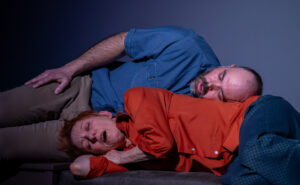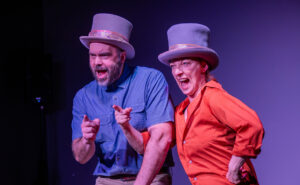
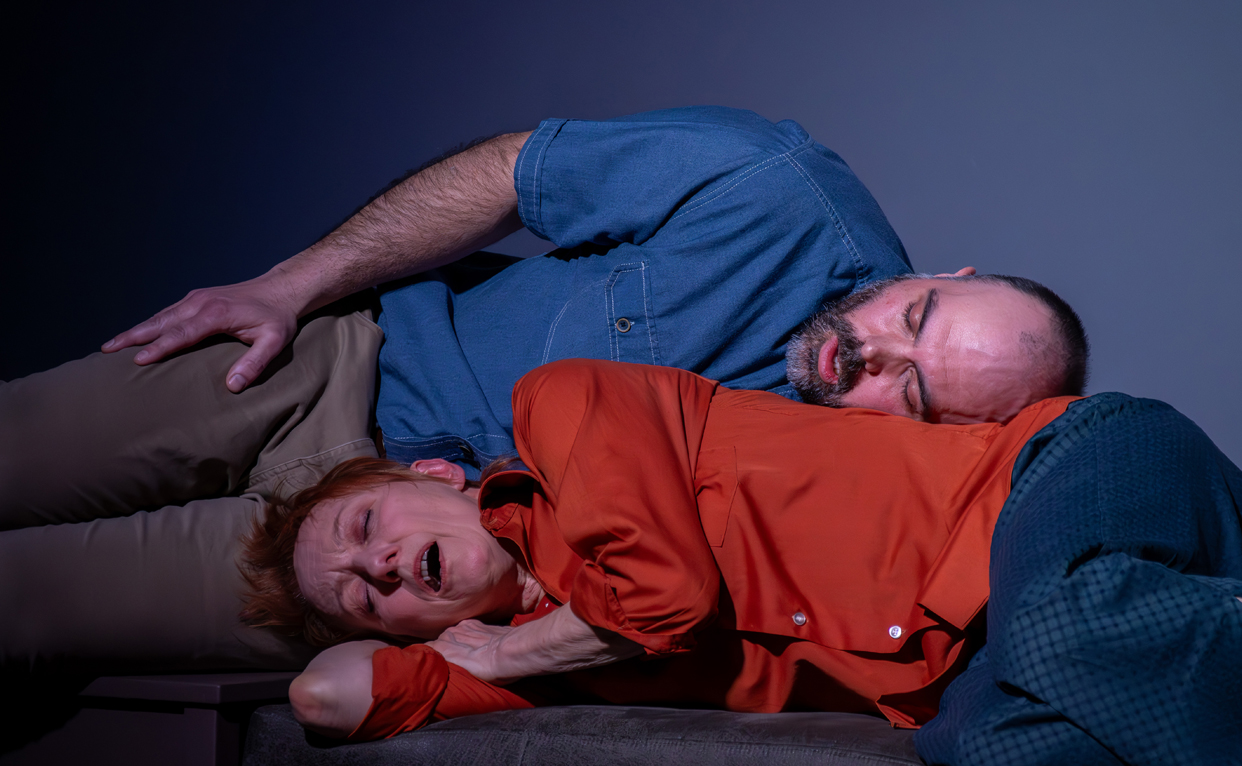
Sébastien LaBelle and Marie-Josée Chartier Photo by Rebecca Driedger
What if you had to literally live with yourself? That is one of the questions that Margaret Sweatman is exploring in her play Fracas, which was staged for three performances this week at the Bus Stop Theatre as part of the inaugural Stageworks collaboration between Eastern Front Theatre and Mayworks Kjipuktuk. This is what happens at the beginning of the play when a person dies and they wake up in a strange sort of limbo as two separate parts of themselves- Bardom (Sébastien Labelle) and Ziggy (Marie-Josée Chartier).
When we meet them they are curled up together like two little kittens, but we don’t know whether they are asleep, unconscious or dead at first. We see them disentangle as they awaken and realize that they are, actually, two separate beings. Bardom seems more stunned and anxiety-driven, and Ziggy is merrier and more driven to create entertainment, and to use story as a means to find meaning. Bardom wants to know what the more objective truth is. They don’t know where they are, what’s happened to them, what the rules are here, nor do they seem to have a clear linear sense of what happened before either. As such, the audience is given a lot of leeway to interpret things for themselves.
For me, I kept thinking about the human brain in terms of electricity, and that Sweatman, director Arne MacPherson and lighting designer Emerson Kafarowski have created these little zaps of fragments of memories, out of context and not necessarily chronological, so it is like their life flashes before their eyes, but not in the typical sense. Chartier and Labelle have a frenetic pace of bringing both Bardom and Ziggy’s current reality, and these flickers from the past to life. At the beginning of the play as both are getting used to existing they are experiencing physical pain and confusion. They exist as two separate entities in their memories too- so it’s not as though we get a clear picture of who this human was in life- we are constantly seeing how the duality of them is interacting together. Sweatman also hasn’t written Bardom and Ziggy to be opposites. They are different, and sometimes they conflict with one another, but they are not this person’s angel and devil battling it out- everything is much, much, much more nuanced than that. At one point Bardom rails against the capitalistic businessmen in their ties, and then realizes that he is also wearing a tie. We are told a story about a bombing at a school (conjuring immediately the school that the Americans bombed in Iran), and we are unsure how this person is complicit. This made me think about how, of course, it’s obvious to point fingers at the military, the political leaders, and the billionaire class who have paid for the government in this context, but when capitalism and fascism overlap how does that make us all complicit? Did we vote for the politicians? Did we vote at all? Did we stand idly by as our institutions were dismantled and pretend it was business as usual because our distraction device made it possible? Did we pretend that when we shopped at the gigantic digital consumerism plaza that our money wouldn’t be used to fund war and poverty elsewhere? At one point Ziggy says that she didn’t save any children. Many of us do try to live our lives in humanitarian terms- we donate to the causes we believe in, and we support our ideals in many theoretical, intangible ways- but how many of us know for sure that we have literally saved a child?
Marie-Josée Chartier is especially dazzling and riveting in the way that Ziggy has this very specific Vaudeville or Musical Hall sensibility- she is very theatrical, popping into songs and dances and sometimes we wonder whether she can see us in the audience, and whether she is trying to rouse us not just to get us alongside her perspective of limbo- but just for the sake of variety. One of the songs sounds like an old PSA jingle or a song from a children’s television show about the importance of taking care of the environment, but then later in the show there is a song that sounds like it’s conjuring the hippie counterculture movement, but its lyrics reflect the exact opposite of this- perhaps a dig at how many Boomers grew up to burn many of the ideals they purported to have as teenagers to the ground once they got a modicum of power and wealth. Labelle’s character might reflect more of the audience’s experience- rooting the stakes of the piece more in the anxiety we feel about the unknown. Indeed, none of us know whether this is the world where Bardom and Ziggy will remain forever- or whether they are in transit somewhere else- and will that place be more or less confusing and unpleasant?
Sweatman’s writing is absolutely glorious. It is both beautifully poetic and continually surprising. One of my favourite moments was when Ziggy asked Bardom if he was her headache. It’s funny, and creative, and there is so much for audiences to get lost in in the writing- in the best way. It is a rollicking reflection on the impact of one single life and its capacity to do both harm and good- to create, to entertain, and to maybe leave something behind that will outlive you.
The title refers to the sound of something breaking apart. It is interesting to think of death as something that smashes a life to pieces, when certainly the grief that coincides with loss can often feel this way. The world- from a municipal level all the way up to a global level- can feel, also, like it is breaking apart under the enormous pressure of our capacity to make the dumbest choices. How do we continue to do our mundane little tasks and find our whimsical little joys in the face of what feels like perpetual impending doom? The curiosity and tenacity of Bardom and Ziggy, and their refusal to abandon one another did leave me with a slightly uplifted feeling upon exiting the theatre. Fracas is very funny, very charming, and leaves audiences with a heck of a lot to consider once they get home too.
Fracas at Stageworks has closed. For more information about CLIFF and A Timed Speed Read of the Triangle Shirtwaist Factory Fire Trial Transcript (with additional notes) please visit this website.
Canadian Theatre Criticism is an essential part of a healthy and thriving theatre community. It helps theatre companies find new audiences for their shows, deepens audiences’ engagement with local artists and the work being created in their communities, and it is one of the best ways to preserve a snapshot of an ephemeral art form for future generations of theatre lovers. TWISI relies on support from its Subscribers, folks like you who care about the survival of local and independent arts coverage. Please consider becoming a Subscriber today, or click here for more information. Thank you so much for supporting TWISI.