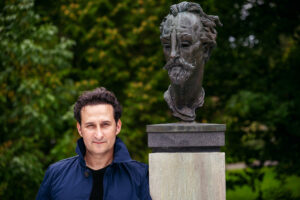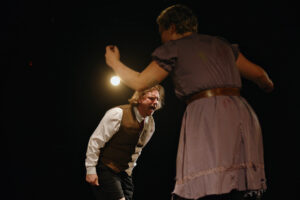
Stewart Legere. Photo by Sergei Tsimbalenko
Tonight I finally made it out to Eastern Front Theatre’s Stages Festival at Alderney Landing. The first show that I saw was the highly anticipated new Zuppa show The Final Recording of an Almost Extinct Bird, written and performed by Stewart Legere and directed by Ben Stone.
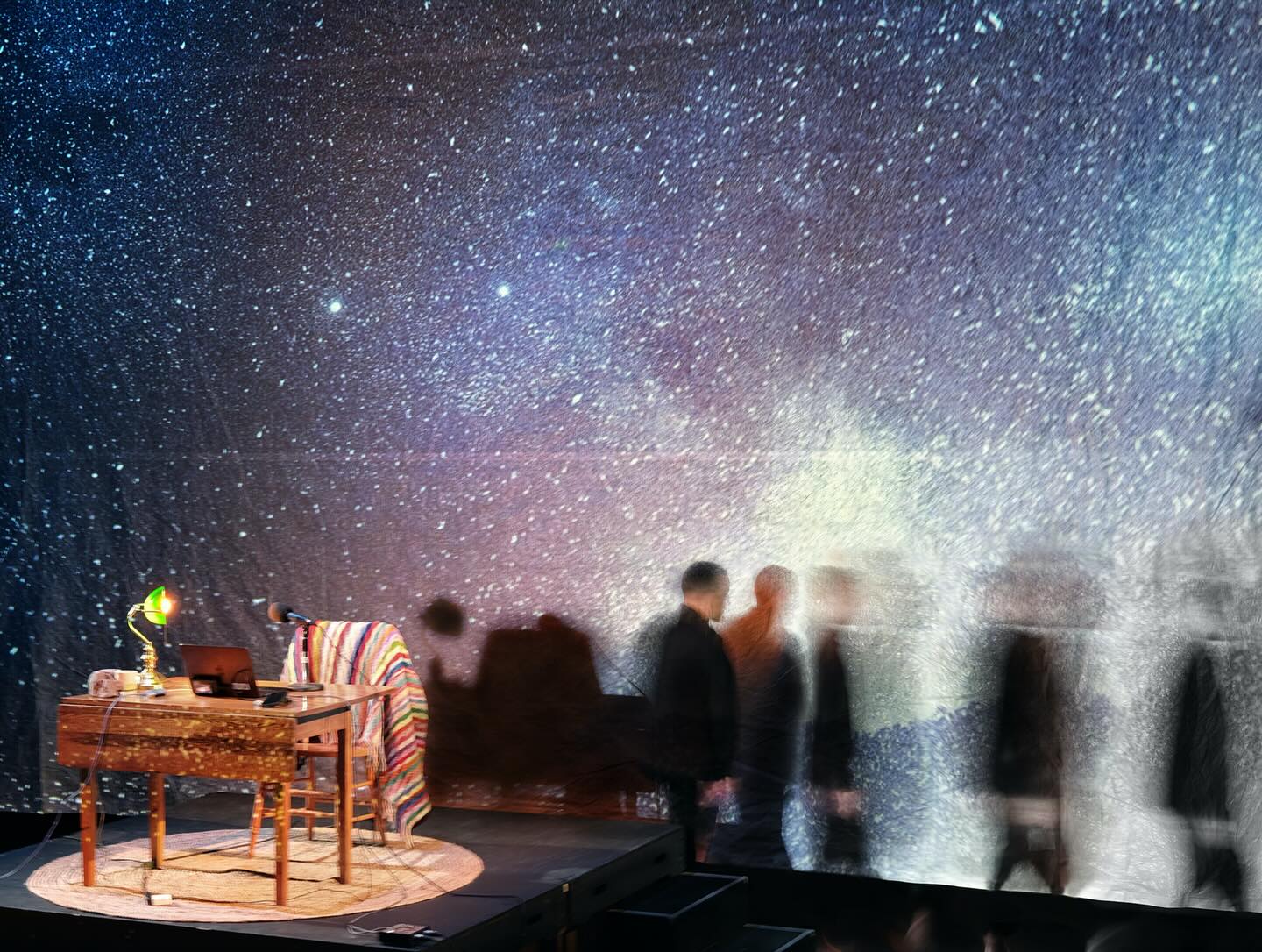
We are introduced to Fred who sits at a desk in front a computer screen and begins to talk to us about astrophysics and geology: the ways in which the universe expands and undergoes massive amounts of change over the course of billions of years, and how the rocks that exist all over our own province are a sort of roadmap that chart out different aspects of this history. Each time Fred mentions a local landmark he also gives us the Mi’kmaw name- not just in deference to the unceded land all around us, but also to help root us more firmly in this epic chronology of time. It is important for us to remember that before the French and the English ever set foot here, the Mi’kmaq were here for thousands of years, and long before them were the dinosaurs and Pangea, and long before them the Big Bang (allegedly). Time is important to Fred. He is trying to make sense of it. As he speaks we realize that he is trying to make sense of everything because he is grieving.
In his grief Fred tries to avoid talking about the rawest and most painful aspects of losing his ex-partner, and instead prefers to paint more vivid portraits of what their time was like together during happier days. Fred’s love for him shines through the most when he is talking about geology. His partner was a geologist with a passion for rocks, and we see that passion has been, to some extent, passed on to Fred. The way that Legere layers these narratives, and especially the way Fred delves in and then retreats from the more painful aspects of this grieving process and diverts his own and the audience’s attention to something less tender, is a very accurate depiction of how grievers often navigate their relationship to the past, present, and future, both out in their everyday lives and alone in their own heads.
The title comes from a track from Fred’s calming playlist of a birdsong (played through gauze), which might help you relax if you didn’t know that the bird singing has been extinct for the last forty years. Instead, it is just another thing to make your mind race.
Legere plays Fred as a very charming person, with self-deprecating humour and a great deal of friendliness towards the audience, but he is also guarded- the humour is a shield; he is adamant about keeping this performance very measured, and as organized and professionally scientific as possible. The more he can keep us at an objective distance from the story he is telling about what happened in the blue chair in the cabin on the North Shore, the more he doesn’t have to relive it either. What is interesting, as well, is that for those of us who know Legere it is hard to see where Fred ends and Stewart begins, which creates an extra layer as we try to figure out: is this story true, are some aspects true, what is the truth? This is similar to what Lee-Anne Poole was doing in her play Talk Sexxxy. Does it matter whether it is true? Does it make it more compelling and heartrending if it is? Is it more impressive if it’s all fictional? Why do we as audience members care so much about this?
Ben Stone directs the piece, which has a soundscape by Legere and projections by Christian Ludwig Hansen, and lighting by Jessica Lewis. The projections both help Fred in the more presentational aspects of the show, so we are better able to anchor ourselves as he speaks in some depth about the way that the universe and time work, and the history of the formation of the earth. At times the projections seem to give us more of an insight into Fred’s mind, which he stresses several times he has tried to quiet, but he can’t. For a Zuppa Show especially this one has a whole lot of words and not a lot of movement. Fred moves from the desk to a mic stand to the side and then back again, and we get a little bit of a sense of time going in circles and the story we are hearing being out of sequential time- I think there is even more for Legere and Stone to play with here. There is a tension, I think, that grows between what the audience wants to hear about- the partner in the cottage- and what Fred wants to focus on. This tension is interesting and comes from a genuine place; at the same time, there may be room to tighten things up a bit so the build of the main storyline doesn’t lose any of its momentum.
I was really riveted by this play and the creative way that Legere is exploring not just grief, but the ways in which we express and don’t express this emotion, and all the memories and experiences associated with it. I hope to see it again in a future iteration!
The Final Recording of an Almost Extinct Bird has closed at Stages.
I am familiar (read: all too familiar) with the idea of “eating your feelings,” but what about eating someone’s else’s feelings?
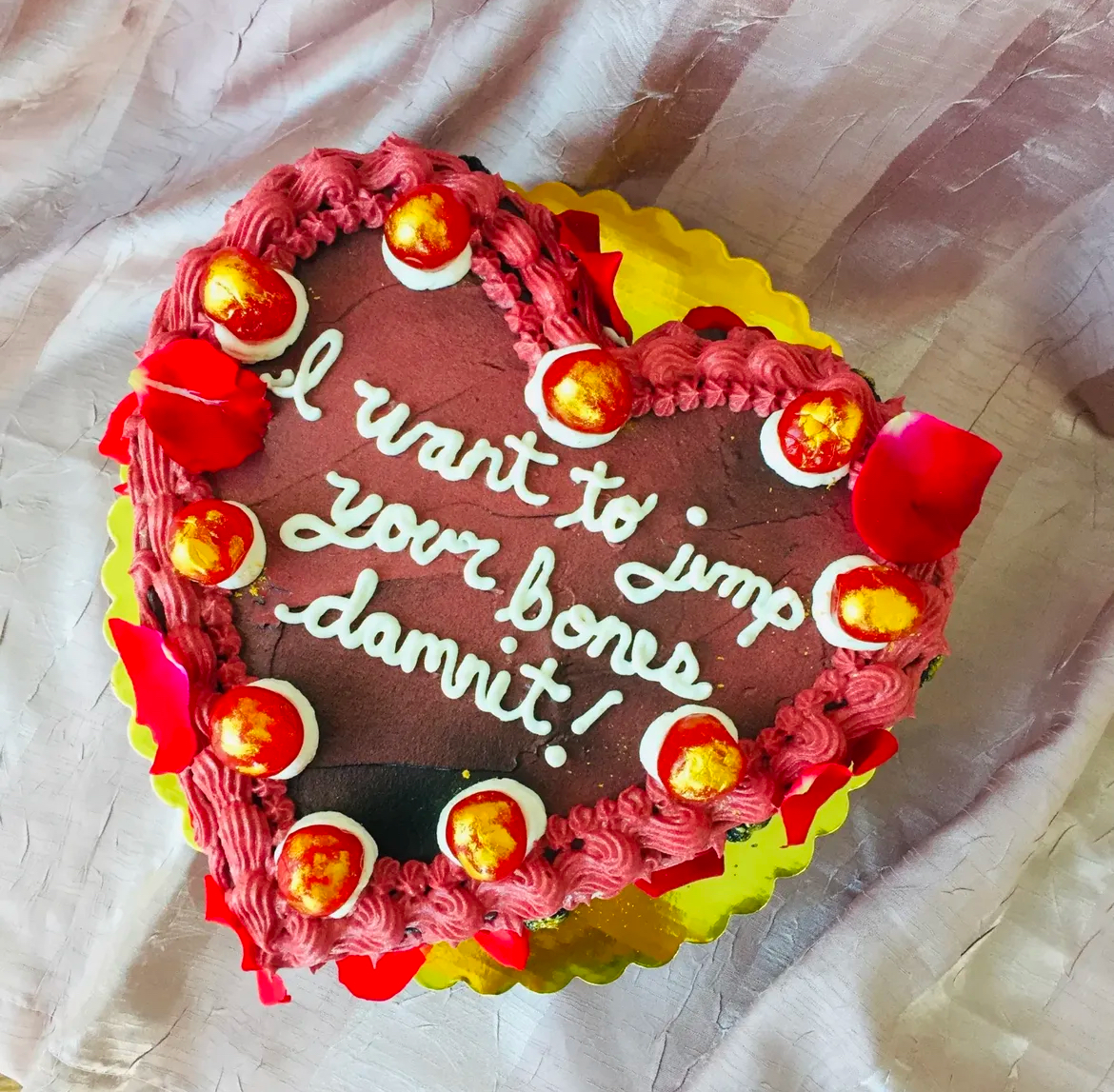
That is the conceit of Keely O’Brien’s play Secret Ingredients. Similar to last year’s The Dead Letter Office Secret Ingredients begins as an art project experiment. O’Brien placed an ad on CraigsList advertising that she would send a free cake to folks who requested one, but the hitch was that the cake needed to convey a previously unspoken message and the cakes needed to be delivered to the intended recipient of that message. Once O’Brien got the first number of orders she set about creating a system by which she would construct specific cakes whose ingredients mirrored the emotions behind the message that was written in frosting across the top of the cake. She created a wheel that matched certain emotions (excited, horrified, jealous, confused etc.) with different tastes, such as fruity, tart, spicy, and bitter. Each cake was completely custom-made using her wheel to decide which ingredients to mix into the cake, whether that be cranberry jam, dates, or sprinkles. She then decorated each one in a way that also mirrored the sentiment of the story she had been given by the person requesting the cake.
Secret Ingredients makes a solid case for the idea that if you put an idea out into the universe the story, or indeed the play, will find you. Each audience member is given a small sample plate with different cakes to taste. O’Brien takes us through a number of her experiences in creating these cakes for folks- telling us what their messages were, from annoyances with neighbours to messages of love. We also hear about how the delivery of the cake went and, in many cases, what the response was from the person who received the cake. O’Brien, who has extremely warm energy, empathizes with each one of the stories she tells, and realizes that through this work she too is stepping out of her own comfort zone and confronting her own challenges around direct and honest communication. She realizes that she will also have to make her own cake and deliver it herself, along with her own difficult message.
Then Syl emerges out of the narrative and things become more complex. Syl wants to send a cake to her partner, but then cancels the order, but then reaches out again. O’Brien begins to develop a closer relationship with Syl as she finds herself becoming more and more invested in the relationship between her and her partner. “Can a cake solve all their problems?,” she wonders.
The experience of tasting each cake after hearing the stories that inspired them was also a very interesting experience. Can you taste the emotions that were baked into them? I find the idea of making cakes with unexpected ingredients interesting on its own as well. It reminded me of the few food experiments that I did as a child playing in the kitchen and mixing up random things- although these were all much more edible. Saying something difficult with a cake that is meant to be simply sweet and delicious is one thing, but how does the message change, and how do we receive it, when the cake itself also, to some extent, contains the difficult message? Will we have to literally choke it down?
O’Brien also makes a cake onstage, so we can all witness the full process ourselves. Last night that even included the cake delivery. I find O’Brien to be a constant delight to watch. She oscillates between true moments of vulnerability, and then also genuine moments of more shyness, as she both delves into the awkward and pivots away from it in a way that feels very human. This is something that both she and Legere have in common, which made seeing these two plays as a double-bill of sorts feel very apt.
Secret Ingredients is a real unique treat that brings audiences together on a poignant and sweet adventure.
Secret Ingredients plays one more time- today June 7th, 2025 at 9:00pm at Alderney Landing Rotunda (2 Ochterloney Street, Dartmouth). Stages runs until June 8th with shows at Alderney Landing, Ferry Terminal Park, and the Dartmouth Common. Visit this website for tickets and more information.
There is a very thorough Accessibility Guide Available Here (Scroll Down). Alderney Landing Theatre is accessible for wheelchair users, there are two all gender washrooms, Phonak Roger FM/DM System available at Alderney Landing Theatre. Automatically connect via Wall Pilots or borrow a Telecoil device to sync with hearing aids and cochlear implants. Devices with headphones are also available. Please see the Box Office for assistance onsite. ACCESSIBLE TICKET PRICES: All performances have pay-what-you-can-afford pricing. If cost is still a barrier, please email info@EasternFrontTheatre.com. Volunteers see shows free of charge! Sign up here.