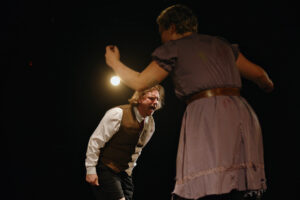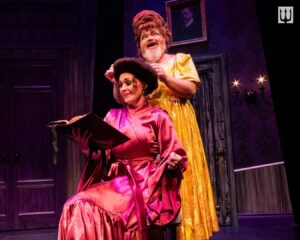

Liam Oko and Maude McInnis in For Love Nor Money
There is a brand new Nova Scotian play premiering at Festival Antigonish this week, a co-production with Mulgrave Road Theatre in Guysborough. For Love Nor Money by Laura Teasdale opened at the Bauer Theatre on July 12th, and it runs there just until July 19th. I chatted with the play’s director Emmy Alcorn, who is also the Artistic Director of Mulgrave Road Theatre, via Zoom, about why this play is especially special to her.
Laura Teasdale was born in Antigonish and studied both at Acadia University in Wolfville and at Concordia in Montréal. She had a long career in Quebec, twenty-seven years, during which time she worked as an actor, playwright, musician, voice actor, director, teacher, and clown, and with companies such as Centaur Theatre, Geordie Theatre, Playwright’s Workshop Montréal, and The Segal Centre. She returned to Nova Scotia in 2019 and has worked both at Festival Antigonish and Mulgrave Road Theatres as both an actor and a playwright. She was working as a Writer in Residence at Mulgrave and teaching one of their drama camps when she approached Alcorn about an idea she had for a new play.
“Guysborough in the 1800s had two prominent families,” Alcorn says, “The Josts and the Harts. One of the sons, Henry Jost, built a house for his fiancée, Carrie Hart; their marriage had been arranged by their fathers.” The house that he built in 1863 is next door to the Mulgrave Road Theatre’s building. “It was their matrimonial home,” says Alcorn, but, “they didn’t end up getting married. And they didn’t marry anybody else. They remained life-long friends until they were in their 80s. She ended up in Antigonish, he stayed here. So Laura told me that story and I’m like ‘100% I want that play. That’s such a fabulous story.’ And Laura was so excited and passionate about it. I knew that she was going to do an excellent piece on it.”
Alcorn says that Guysborough has a rich history, especially because it was once a major port back in the 19th Century. “There were famous people who came through here,” she says, “but it’s not always easy to find a playwright who wants to write a play in historical context like Robert Chafe does. He’s really good at that, and he loves doing that.” The conceit of this show for Teasdale was imagining what the conversation was like between Henry and Carrie that led to them deciding that they should not get married after all. “[Laura] has done her research. We have the Old Court House Museum, we have a Historical Society here, and so she was able to do lots of research, and Guysborough is filled with storytellers.” She cites one local historian, Jamie Grant, saying, “he knows all the history, and he talks about it as if it happened yesterday. He’s immersed in it. So, there’s a lot of factual things [in the play]; the context is historical and factual, but the conversation is fictional.”
“It’s a beautiful piece of writing and the two actors, Liam Oko and Maude McInnis… [are] just brilliant. I feel like I’ve been given a gift. They have chemistry between the two of them. They work hard, but they’re playful; they’re open to trying everything.” She notes that the actors barely leave the stage, and yet they have to play their characters at different ages as the play travels through time.
Oko and McInnis both just graduated from the Fountain School of Performing Arts and Alcorn was able to see them during panel auditions that are set up between Eastern Front Theatre and the Fountain School each year where graduating students audition in front of a panel of Artistic Directors from around the province. Alcorn says that she was so grateful that she had attended the panel, otherwise she wouldn’t have seen these two young performers. “It was a very collaborative rehearsal process,” she says. “I came in with my vision and my ideas, but it was very back and forth, and any time we needed a solution they would offer stuff, so we were really working on it together, and delving into the psychology of these two characters. What were they thinking? What did they want? What were their goals? And with a new play you gotta come up with that stuff yourself. You can’t go and see another production of [the play]… you can’t steal anything,” she laughs. “It’s a real privilege to be able to direct a new play, but also, it’s daunting. You want to honour the playwright, you want to honour the story, and you have to be really inventive, especially [with just] two actors, and it’s practically a bare stage. So it’s exciting. The audiences are loving it [so far], [there’s] lots of laughter. It’s not a comedy,” she clarifies, “but it’s the laughter of recognition- you hear a character talking about something that you’re struggling with right now in your own life- but it’s 1865… sometimes [audiences respond to hearing] a place name or a family name… even young people, the young women at the Box Office, they came to the Dress Rehearsal… they’re in their 20s, and they absolutely loved it.”
Alcorn says the beauty of Teasdale’s script is that you don’t have to know the history of Guysborough at all to appreciate the story and feel immersed in the world of the play. Yet, for some folks the history is personal- they had Carrie Hart’s great great grandniece at one of the performances. Alcorn says that the family names of many of these settlers are known in the town because the Historical Society has put the names of the first families who lived in the historical houses and the dates they were built on the homes themselves so locals and tourists can learn more about the local history. Alcorn took Oko and McInnis, the show’s stage manager, and Teasdale to Guysborough to show them Jost’s house. “We went up to see Henry’s gravestone, and down to the wharf because it’s the Jost Wharf building…” and Alcorn tells me that their own theatre, Mulgrave Road Theatre, had once been Henry’s office. “That’s where he was doing all his accounting,” says Alcorn, “right in this building… upstairs. I wrote in my Artistic Director’s Note [in the programme]: it’s far away, but it’s still very close. Sitting up there, that’s where Henry was, where I’m trying to do my work. It feels like the closest play to this theatre because of the connection to this building.”
The history of Mulgrave Road Theatre dates back to 1976 when Robbie O’Neill got a Canada Council Grant to write and produce one play about Guysborough, which had recently experienced an economic decline due to the construction of the Canso Causeway, which links Mainland Nova Scotia to Cape Breton Island, which was finished in 1954. In 1972 Paul Thompson and a group of actors from Theatre Passe Muraille in Toronto went out to Clinton, Ontario where they lived and worked with local farmers, watching they way they lived their lives and listening to their stories. Then, collectively, the actors created The Farm Show, arguably Passe Muraille’s seminal work, which premiered in a barn which the actors had also used as a rehearsal hall. It was a huge success and a pivotal moment in the Canadian Theatre. “The interest in telling rural stories, which you did not see, you didn’t see Canadian shows on the stages of Canadian Theatre, [stemmed from The Farm Show,” says Alcorn, citing that at that time it was American and British plays that were being produced at the regional theatres. Robbie O’Neill, Michael Fahey, Gay Hauser, and Wendell Smith came to Guysborough and did a similar thing- they interviewed the fishermen who lived here, and their wives, and together they created The Mulgrave Road Show. “Mulgrave Road is significant because of Charles Bruce, a famous Canadian writer and journalist… [he] lived on the Mulgrave Road, which is the road from Guysborough to Mulgrave. And he’s written all kinds of stories about that… and he has a book of poems, and one of them was called The Mulgrave Road… so that’s where the name Mulgrave Road came from.” The intention was for the actors to come and do this one play in Guysborough and then leave and move on to other things. Alcorn notes that they had no idea how the process or the product was going to be received, especially since it was such an odd thing to do in 1976, to interview rural folks and then make a play about their lives. “They didn’t know if they were going to be run out of town,” says Alcorn.
But they were not run out of town at all. In fact, it was the very opposite. The audiences loved the play, and embraced having theatre there, and so Mulgrave Road Theatre was born. Alcorn has been the Artistic Director for most of the last 30 years, beginning in 1995. Last summer the ground was broken for the new Mulgrave Road Centre for the Arts, which is set to be completed next summer, which is also the theatre’s 50th Anniversary.
Alcorn says that living and working in Guysborough, which is two and a half hours away from Halifax and two and half hours away from Sydney, can feel isolating. She notes that until recently she was the only professional theatre artist in town. Now Stephen Cross, founding Artistic Director of the Irondale Ensemble Project, and choreographer Andrea Leigh Smith have moved to town, which Alcorn says is wonderful because it allows her to have inspiring conversations with other theatre folks while she’s home. Being so far away from the theatre centres elsewhere also means that Alcorn sees less theatre, but she says being in Guysborough is also great, and she’s grateful to have developed such a great working relationship with Andrea Boyd, Artistic Director of Festival Antigonish, and all the folks working there.
“They’ve created such a great vibe [at Festival Antigonish],” she says, “We feel so welcome and everybody’s helpful and everybody gets along… Andrea and I had been talking for a while about [wanting] to find a project that we could do together. I suggested this [one] and she really liked it. And there’s mentions of Antigonish in the play… there’s a connection between the two communities in it. So it’s kind of perfect.”
It also brings Alcorn back to the town where she spent her formative years. She was born in Trinidad, and lived in New Brunswick and New Hampshire, but she spent most of her school years in Antigonish, which she considers her hometown. She also was in her first play, before Festival Antigonish was established in 1987; she was a child in the crowd scene of Brigadoon. “I’ve been hanging out there for 50 years,” she says, “so the Bauer Theatre’s kind of home in a way.”
“There’s just so many levels of connection with this production, and the way we’re doing it, and the people involved. There have been some really interesting synchronistic moments that have happened throughout this process, so it’s pretty cool. … Laura Teasdale loves these characters, and you can tell that she’s written the play with so much love, and that has permeated through the whole production. There’s just such a wonderful feeling in the room.”
Mulgrave Road Theatre and Festival Antigonish’s production of For Love Nor Money by Laura Teasdale runs at the Bauer Theatre (4130 University Avenue, Antigonish) until July 19th, 2025. Performances run Tuesday to Saturday at 7:30pm, with a 2:00pm matinee on Saturday July 19th, which is also a Relaxed Performance. Tickets range in price from $25.00 for students ($30.00 for seniors), to $45.00 for Prime Seats. They are available online here, by calling the Box Office at 902. 867.3333 or drop by 4130 University Avenue in person.
Incoming search terms:
- https://www twisitheatreblog com/?p=5762