
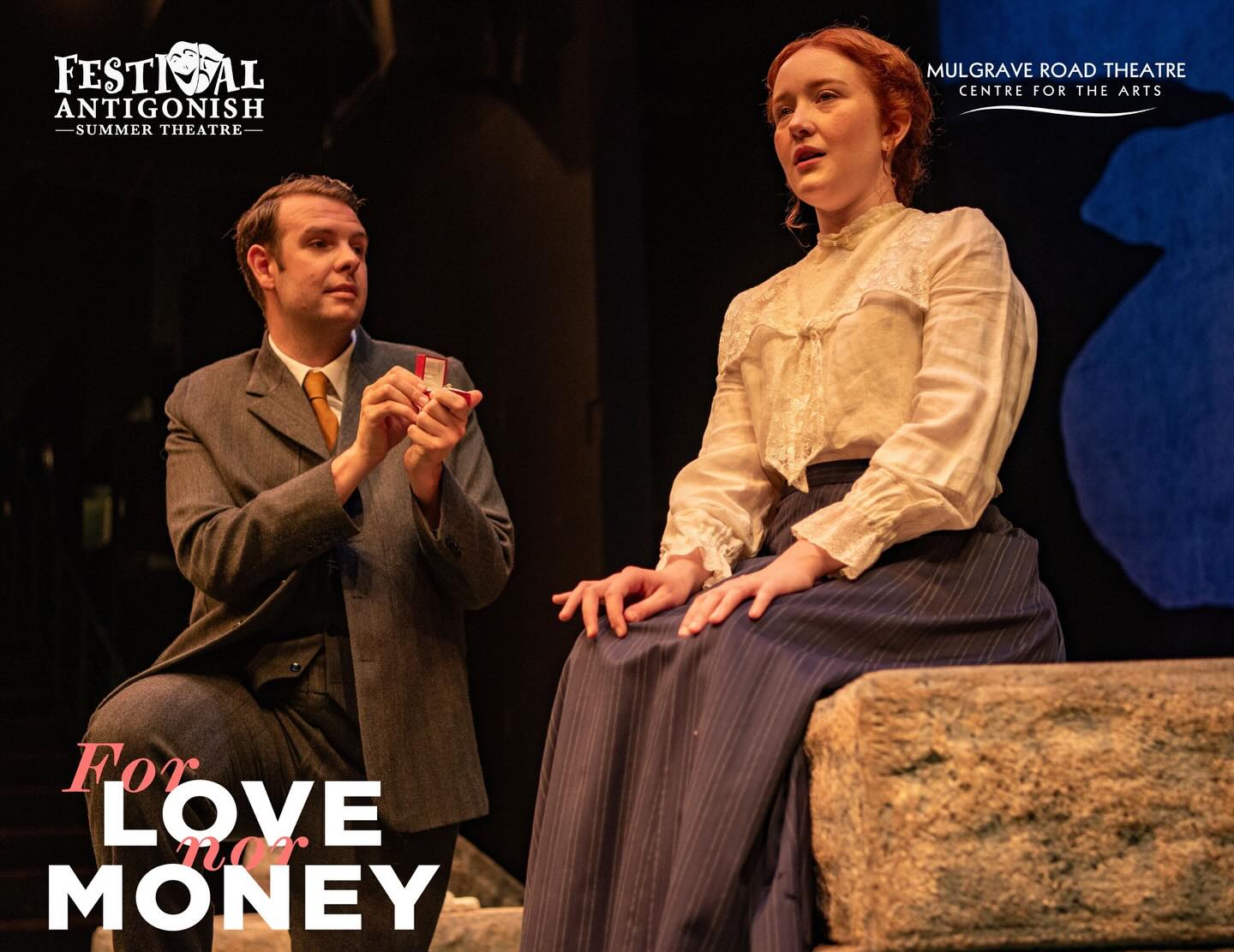
Liam Oko and Maude McInnis
In For Love Nor Money written by Laura Teasdale, which closed yesterday, July 19th, at the Bauer Theatre in Antigonish, we meet the children of Guysborough’s two most prominent families in 1865. Their matrimonial house has been built and their wedding day approaches, and yet, something feels off between the two of them.
The following review contains a few spoilers, so please only proceed if that doesn’t bother you.
The play is based on some true facts in Guysborough’s history. The fathers of Henry Marshall “Marsh” Jost and Carrie Hart really arranged their marriage in hopes to merge their financial and business interests together for future generations. And yet, something happened that scuttled these plans, and in this play Teasdale imagines what that something might have been. In real life, neither Carrie nor Marsh ever married, and the two remained lifelong friends.
Marsh Jost, played by Liam Oko, is considered “peculiar” by his neighbours and family members in the community, and to today’s eyes he seems to be on the Autism spectrum. A rigid routine is important to him, he has an extensive knowledge of the details of architecture, and he feels the most confident when following the steps of a carefully, meticulously planned future and the expectations that he knows his parents have for him. Since childhood his best friend was Carrie Hart, a vivacious tomboy who is just one year younger than him, and who loves to dream of a future where she might be completely liberated from all the expectations that have been placed on her simply because she was born a girl.
Teasdale takes us back to the fraught day eight years earlier when thirteen year old Carrie and fourteen year old Marsh first learn that their futures have been amalgamated by their pragmatic and ambitious fathers, and they are to be married. We also see the most dramatic day in their relationship- the first time that Marsh pulls away from Carrie, due to a disturbing incident that happened to him while at school. We also see a scene that takes place far in the future, but most of the play occurs the day that Marsh has finally, after two years, finished building their home, on a piece of land where they have played together for their entire lives, and we see them standing facing their house and contemplating the finality of it.
Liam Oko plays Marsh, sober, task-oriented, and oscillating between a shyness and awkwardness that seems to be the way he usually presents in the world, and a more excited tendency to share his passions and to lecture Carrie on his very sensible, patriarchal world view, since she is the person he feels the most comfortable with. Maude McInnis plays Carrie very much like Anne Shirley or Jo March; she is sweet, self-assured, smart, with a heart that loves books, poetry, music, and who longs for financial independence. Together we see two people whose deep care for one another doesn’t have one iota of romantic spark or chemistry, and whose visions for the future are completely different.
Teasdale has done excellent research and has really rooted this play beautifully in the stories of these two families and the history of Guysborough. The only question I had, dramaturgically, was wondering why Marsh, a businessman, was going to the Truro Normal School, a training school for teachers. The audience gets a rich sense of this world, and I loved the way that the play starts with a hilarious and unexpected reference to a famous historical event, which roots us even more ardently in both time and place.
It was interesting to me that Teasdale doesn’t offer the audience one clear definitive reason why Marsh and Carrie break off their engagement and we never see the scene where this happens. Instead, we have an array of reasons to infer from, some much more overt, and some that seem to be more vaguely alluded to- the audience seems to be in charge of whether we read deeply into these allusions or not. Is Marsh gay? Is Carrie a lesbian? Is Marsh asexual? There is definitely a version of this play where all these things are possibly true, but you can also see the story as being just about two people who are completely unsuited to one another, due to their disparate interests and political views, and who come to this eventual realization. Yet, while it is clear why Carrie never married after this engagement was broken, regardless of which reason you choose, it is less clear why the same is true for Marsh. Surely, between his family’s reputation, his savvy business sense, and his diligent work ethic that led to him being extremely wealthy, he could have married nearly any suitable young lady in county, regardless of the quirks of his personality, and he could have had the family that he wanted so badly.
I would have liked to see more interactions between Marsh and Carrie that explore the ways in which they are suited to one another. We understand that they have bonded from childhood because they are both considered odd and we hear a little bit about how when they were much younger they both yearned for a life of travel and adventure, but what made them both believe, for eight years, that being married to one another would be tolerable, even pleasant, that stopped them from coming to this final realization much earlier? Carrie’s views on how much she will lose through marriage are unchanged from the time she is thirteen until she is twenty-one, and yet when the prospect of maybe losing Marsh and not marrying him arises while he’s still at school she is despondent. It would be interesting to explore more of the complexity around Carrie’s feelings here- why does she want to get married, why does it HAVE to be Marsh? What are the stakes for her in not getting married, and what exactly is it that finally makes her feel like those stakes aren’t high enough to hold her back?
Emmy Alcorn directs the piece and finds lots of movement for the actors in a scenario where they spend a great deal of time standing in front of their house reminiscing, and where they need to find creative ways to introduce props and costume pieces without leaving the thrust stage. There were a few moments where the back of one actor blocked the face of another from where I was sitting, which is one of the biggest challenges of this type of stage, but for the most part I found that even as the actors moved, and faced my way or did not, I could vividly imagine their surroundings and felt how deeply connected they were to this land.
There are a lot of beautiful moments in this play, and I especially loved the way Teasdale uses the symbolism of the matrimonial house standing there in intimidating finality. My favourite line is when Carrie says to Marsh, “don’t let this town tell you who to be,” and I did feel as though both of them were behaving as though once they crossed the threshold of the house they would magically transform into exactly who they were expected to be. This is a really fascinating idea, and one that I think really resonates with people across generations, that ‘once this one tangible thing is accomplished, then my whole life will transform and I will finally be happy.’ And for Henry Marshall Jost and Caroline Hart, that eventual transformation in their lives wasn’t at all what was expected, but, hopefully in the end it was just as they had dreamed it should be.
For Love Nor Money by Laura Teasdale and directed by Emmy Alcorn is a co-production between Mulgrave Road Theatre and Festival Antigonish. This production has closed.



1 thought on “For Love Nor Money: A Thoughtful Play About Expectation & Marriage”
Comments are closed.