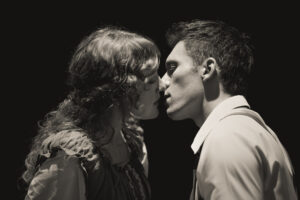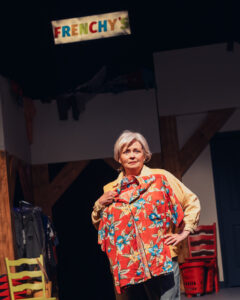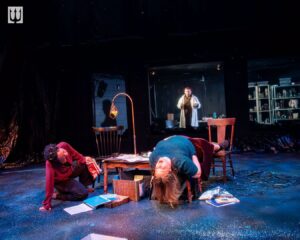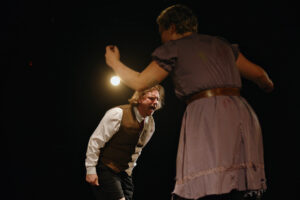
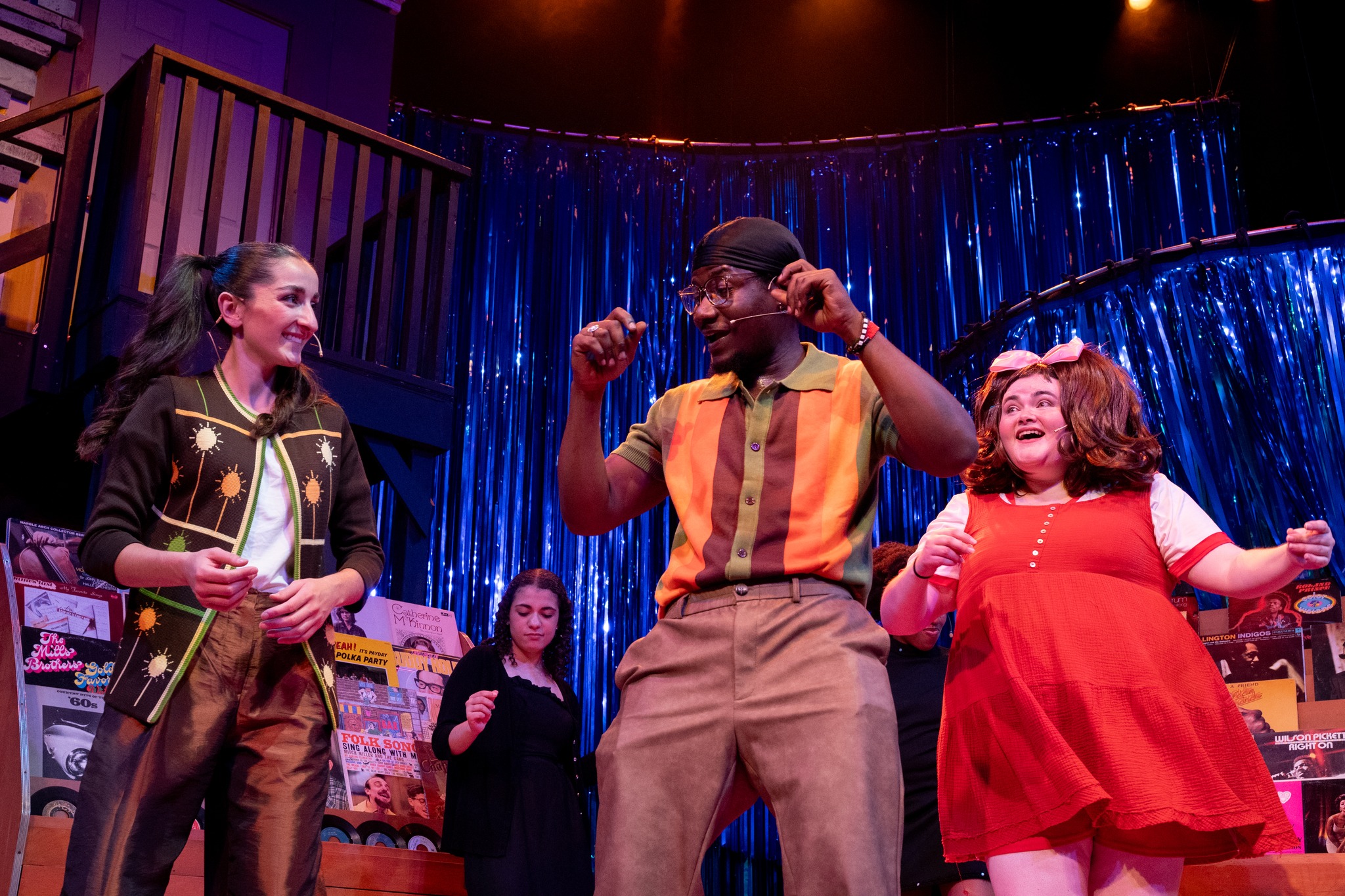
Mea Tonet as Penny, Sean Malikyns as Seaweed and Jacqueline Winters as Tracy. Photo: Corey Katz.
I had the opportunity to watch a very high quality recording of the Highland Arts Theatre’s production of Hairspray, directed by Wesley J. Colford, which was provided to me by the theatre so I’d be able to see it and write a review. Unfortunately, the show closed on August 3rd, 2025, but you never know at the HAT when there may be a revival in the future of an audience favourite. I knew I was in trouble when we were just about fifteen minutes into this show and I was already tearing up. In fact, it was probably better for everyone that I saw this one in the comfort of my own living room (my dog also enjoyed it!), as I basically cried through the entire thing.
Hairspray is a 2002 Broadway musical written by Marc Shaiman, Scott Wittman, Mark O’Donnell, and Thomas Meehan, based on the John Waters 1988 film of the same name. The show is set in Baltimore, Maryland in 1962 and we meet Tracy Turnblad, a plus-sized High School student, who dreams of someday being able to dance on The Corny Collins Show, a Mickey Mouse Club type variety show that features talented teenagers local to Baltimore. When one of the dancers has to leave for an unexpected nine month hiatus, auditions are held to find her replacement and Tracy defies the concerns of her mother, Edna, and goes down to the studio to dance for the show’s producer, Velma von Tussle, a racist and fatphobic stage mom who derives all her value from the fact that she was once Miss Baltimore Crabs. Velma, of course, rejects Tracy on sight. With a bright spirit for justice, Tracy connects for the first time with some of the Black students at her school, Seaweed J. Stubbs and his sister Little Inez, and as the play progresses she becomes more and more emboldened not just to get on the show for herself, but to see that The Corny Collins Show becomes desegregated, to send a national message that dancing on television should provide equal opportunity for everyone.
Marc Shaiman and Scott Wittman have created a truly iconic score for this musical, which remains equal parts rooted, of course, in the best of the 1960s, but also remains completely timeless in its frenetic joie de vivre. There are no weak links in this musical; every single song is perfectly constructed, whether it be “It Takes Two,” the power ballad Link Larkin, the hunky crooner on The Corny Collins Show sings to initiate Tracy onto the show, or “Welcome to the 60s,” a celebration of the decade’s new sound and the optimism of the early Kennedy Era where Tracy entices Edna to ditch her housedress and feel empowered to not let her age or her weight stop her from dreaming of a brighter tomorrow.
In Sydney Colford has assembled a powerhouse cast for this production, headed by Jacqueline Winters as Tracy. Winters is the ultimate ingenue here. The audience really feels that she is fifteen or sixteen years old, still navigating her big emotions and running headlong into the boundaries her parents (well, really just her mother) still have for her. She is sweet, and naïve in a way that is motivating for her, because she doesn’t have the benefit of experience to make her cynical or more pragmatic. Winters is an excellent dancer and has a big voice- and while she does sometimes channel Marissa Jaret Winokur (Broadway’s original Tracy), or Nikki Blonsky from the 2007 film who both give Tracy a very, very bright almost cartoonish high singing voice, Winters’ is more grounded, which gives her more of an Everyperson quality.
The very talented Arianna Boakye plays Little Inez, Seaweed’s elementary-school aged sister who also wants to dance on The Corny Collins Show, and she symbolizes the hope the older characters have- that Little Inez will have an easier time when she gets to High School than her brother has had. Sean Malikyns plays Seaweed as a sweet, sort of nerdy counterpart to Tracy’s best friend Penny, who, nevertheless, has some sweet and unique dance steps up his sleeve. Seaweed becomes more emboldened when he is singing, and Mailkyns’ voice really suits the 1960s R&B style of the musical beautifully. Felicia Headley plays Motormouth Maybelle, Seaweed and Little Inez’s mom, who hosts the monthly “Negro Day” special on The Corny Collins Show, which is the only time when the Black dancers are allowed to be featured, but they must not be accompanied by any white teenagers. Headley brings down the house with her torch song, “I Know Where I’ve Been,” which is sure to bring even a tin person to tears.
Ian Furlong is excellent as the well named Corny Collins, very much like Vince Fontaine in Grease, the charming host with the radio announcer voice who fancies himself to be hip with the kids, even though his High School days are well behind him. He sings the commercial “It’s (Hairspray)” as part of the Miss Teenage Hairspray Competition, which is just flawless in capturing the heyday of the American jingle. Similarly, Maverick McDougall captures beautifully the crooning heartthrob Link Larkin, while Mackenzie Sechi is vicious as Link’s snobby girlfriend Amber, a girl desperate to win the hairspray crown at.all.costs. Sechi has a stellar voice, and she reads as easily two years older than Tracy, which makes the power dynamic between the two girls even more fraught. Anique Mercier plays Amber’s even more coldhearted mother, Velma, and she has a formidable stage presence, with a voice to match; she hit a note at the end of “Miss Baltimore Crabs (Reprise)” that was so high, maybe they even heard it in Baltimore. The note wasn’t just for impressive effect either, it really beautifully captured the frustration that Velma was feeling in that moment, and the ways in which she is used to throwing her power around. Mea Tonet plays Tracy’s best friend Penny, who is not so much ditzy, as completely oblivious by times, but who has a real heart of gold and, arguably, even more courage than Tracy when it comes to zealously following her heart and doing what’s right. Tonet also has a powerful voice, and she creates a very funny, dorky, little person in Penny: a free spirit who is very easy for audiences to fall in love with.
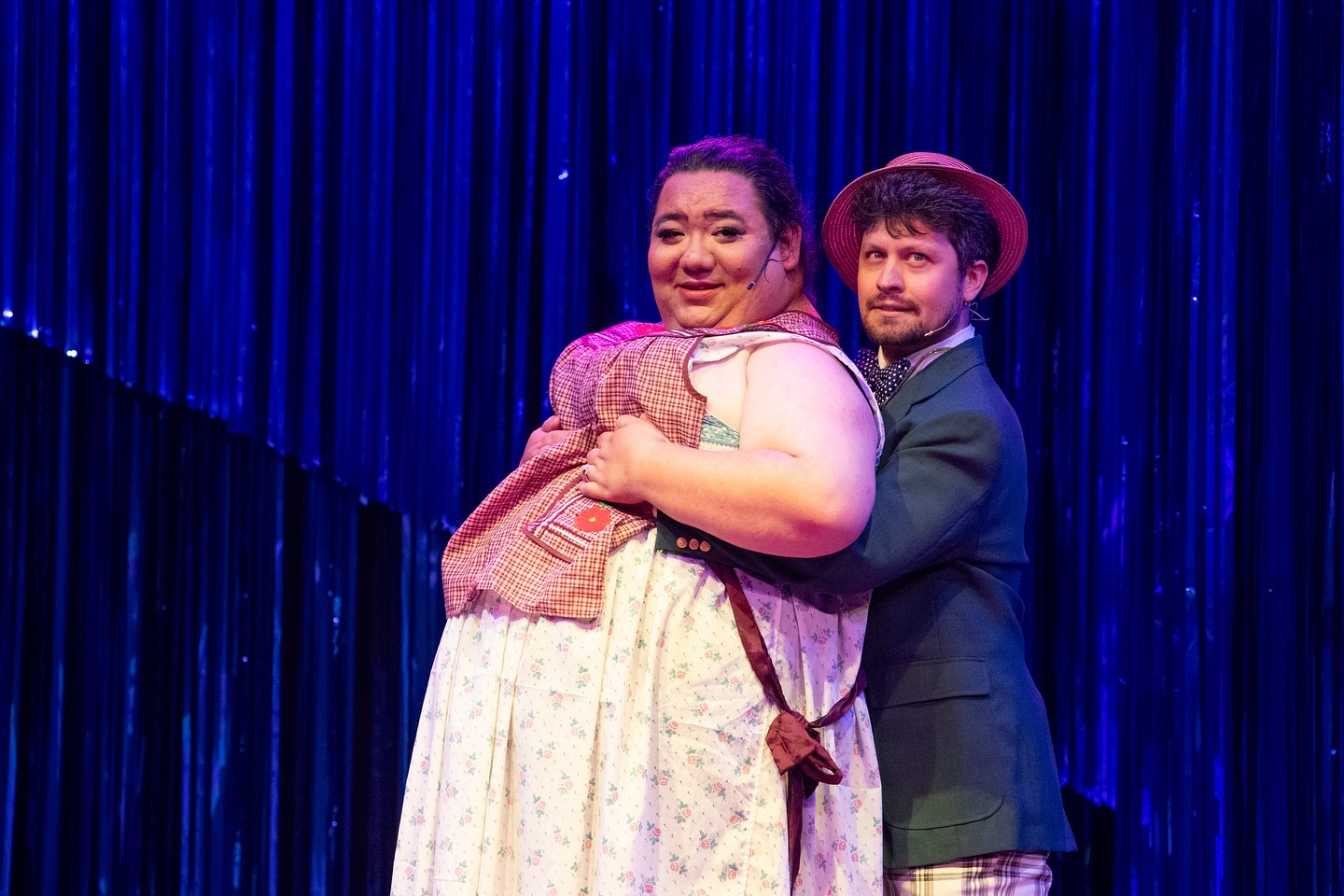
Nicholas Porteous and Chris Tsujiuchi play Tracy’s sweet parents Wilbur and Edna Turnblad. Both Wilbur and Edna are crazy about Tracy, but they have different love languages. Wilbur is doting and permissive, a dreamer himself, who runs a joke store, and who expresses himself largely through silliness. Edna is anxious and restrictive, but also deeply sincere in the way that she easily expresses her feelings to her two beloveds. Their duet together, the love song “(You’re) Timeless To Me,” is one of the highlights of the show. Tsujiuchi also excels especially with Edna’s characteristically dry wit, and does he ever know how to take a comedic beat. In the performance I saw he had a little Nathan Lane moment where he acknowledged a woman in the audience who had a magnificent outfit, and managed to both break the fourth wall, but also remain in character and in the world of the show. It’s a sign of the times, but also a testament to Tsujiuchi’s performance, that unlike when I saw clips of Harvey Fierstein in the role, or when I saw Jay Brazeau play the part in Toronto in 2004, or John Travolta in the film, the fact that Edna is played by a person in drag isn’t inherently where the comedy comes from anymore. I felt like this production was the first time that I really just saw Edna for who she was, a middle aged woman who had spent the last fifteen years or so giving everything she had to the bright young apple of her eye, and who struggles to remember how to centre her own happiness, but who is able to do so because her daughter and her husband love her so much and want to see her living the big, beautiful life she deserves. I’m going to cry again.
The show has vibrant choreography by Aaron Aquino-Annobil and Nicole Rosove that really brings all the vivacious teenage-centric beachy, carefree uniquely 1960s ambiance to life, while also showing the nuanced disparity between the way the white kids dance versus the Black kids, with Tracy, Seaweed, Penny, and Little Inez adamant to bring the two styles together. Velma mentions that Amber’s dancing was “atrocious,” insinuating that her success on the show is largely due more to nepotism than talent, so I think there’s room for Amber’s dancing to be more obviously worse than that of her peers, to comedic effect. Wesley J. Colford has a big challenge carving out space on the HAT’s stage for a large array of different physical spaces, often with characters in the same scene but in different locations. They do this by making good use of levels, and with Joe Pagnan creating some compact sets that can create intimate little playing spaces that can easily be removed. The pace of the show is fast and furious, like a train headed for the blockbuster finale “You Can’t Stop the Beat,” and Colford does a great job of keeping a large cast of bodies moving in a small space. Kayla Cormier’s costumes also contribute beautifully to this big, bright, beautiful world of 1962, and incorporating some of Rita MacNeil’s dresses into the show, I think is just so magical and poignant. I did think there was room for Tracy’s hair to be even more absurdly cartoonish.
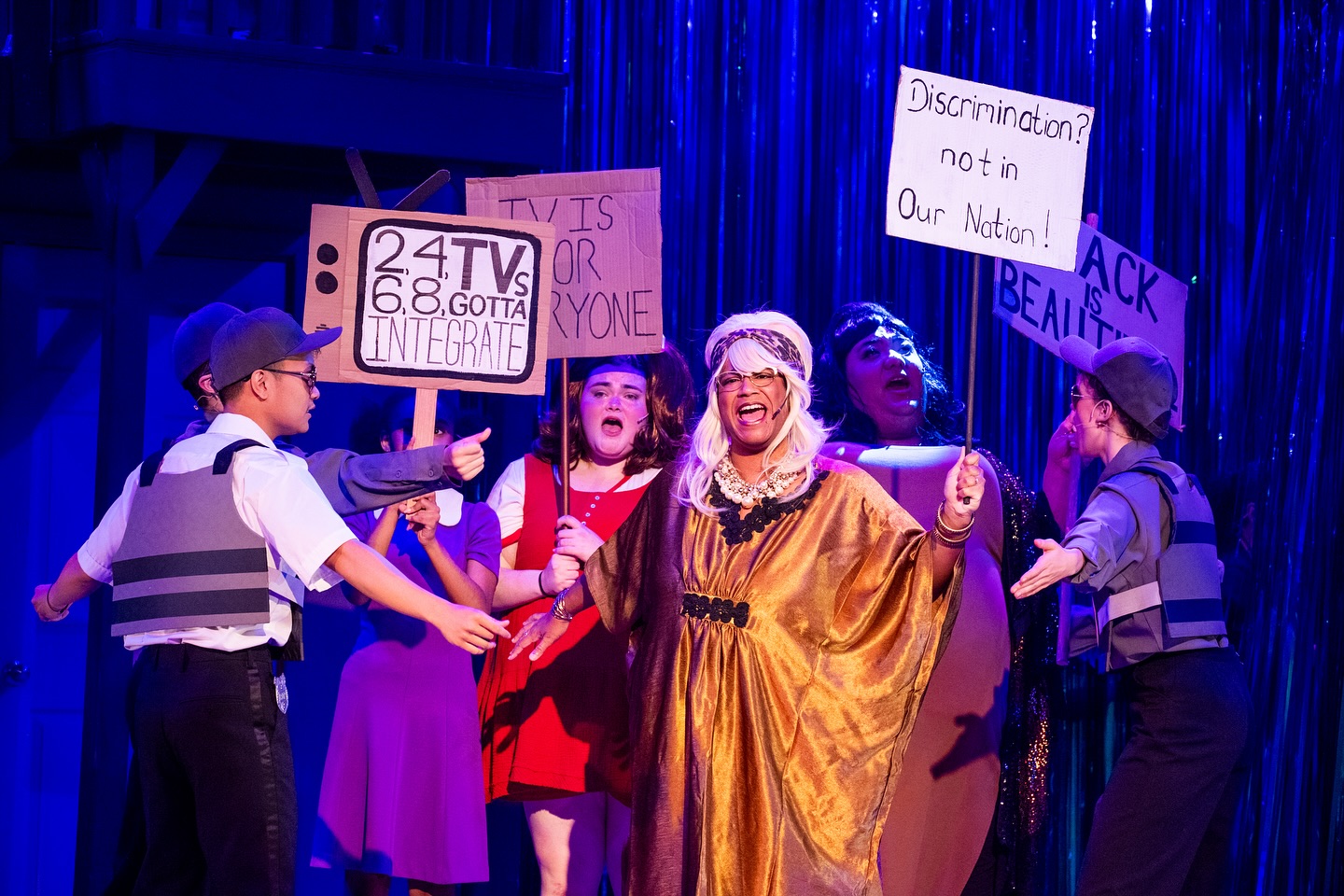
Hairspray opened on Broadway on August 15, 2002, which means that it was during my first and second year of university that I was absolutely obsessed with this show, although I continued to listen to the cast album on heavy rotation for the next decade (and now I’m judging myself for having ever stopped). As the plot progressed towards “I Know Where I’ve Been” and then nicely wraps itself up in a convenient little bow at the end, I found myself thinking about being a little bit older than Tracy in 2002 and the political and cultural climate of that time. Coming out of the extremely fatphobic 90s, which glamourized “heroin chic,” and heading into the era of America’s Next Top Model, a story about Tracy, a girl who looks like a lot of average American (and Canadian) girls, was much overdue on Broadway. Yet, the subplot about racial segregation, I think, was always intended by the white creators to be a reminder of how far the American story had progressed since 1962, which in hindsight seems naïve. Today, Motormouth Maybelle’s line, “Nobody ever said this was gonna be easy. If something’s worth having, it’s worth fighting for. Children, you were not the first to try and you won’t be the last, but I am here to tell you that I’m gonna keep lining up until someday somebody breaks through. And I’ve been looking at that door a lot longer than you” hit me in a much more immediate way than when I’ve heard it before. In 2002 I thought, like I think a lot of white people naïvely thought, that progress was linear: you break down that door, and you march through it, and it stays broken down, and you build upon the foundation of that broken down door. Now, of course, I know, most of us know, unfortunately, that isn’t the case, and the subplot of Hairspray seems to be more of an alarm bell than a harkening back to a piece of “now resolved” American history.
Hairspray is the story of a little white girl, a teenager, who puts everything that is important to her: the dream job she almost didn’t get because of her size, the love of the boy who she never thought would be interested in her, and her own physical body, on the line because she believes that racism is wrong. Even when she thinks she has lost everything, she knows that she, as a plus-sized white person, is not free until everyone else is just as free. In this way, Hairspray is even more relevant today than it was twenty-three years ago, in Sydney, in Nova Scotia and Canada more broadly, but especially in this moment in the United States. The fact that we are over six decades into the future that Motormouth Maybelle dreams about with such fortitude in “I Know Where I’ve Been” is both humbling and depressing and I think the reason why I was crying so much seeing this show. Progress can be so tenuous; we cannot afford to be complacent, but seeing this cast up on the Highland Arts Theatre stage filled me with delight, and with hope for the community here, for us in Nova Scotia, that our future, at least, is still one to sing and dance about.
Hairspray at the Highland Arts Theatre has closed. Check out the HAT website for what’s coming up there next!
Incoming search terms:
- https://www twisitheatreblog com/?p=5827