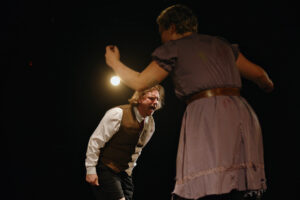

Michelle Monteith Photo by Dahlia Katz
2b Theatre has won the prestigious Scotsman Fringe First Award for their production of Hannah Moscovitch’s play Red Like Fruit, which runs at the Traverse Theatre until August 24th as part of the illustrious Edinburgh Fringe Festival.
The Edinburgh Fringe Festival is the world’s largest performance arts festival, which featured over 3,700 different shows over more than 200 different venues showcasing work from 60 different countries in 2024. It was established in 1947 as the theatre offshoot (or “fringe”) of the Edinburgh International Festival, which also included music and visual art. This festival inspired similar un-juried, open access Fringe theatre festivals to pop up across Canada, beginning in Edmonton in 1982, and Halifax’s own Fringe got its start in 1990.
The Scotsman, a daily Scottish newspaper with its headquarters in Edinburgh, has been integral to promoting shows at the Fringe Festival there since its inception. Originally, the newspaper sought to review every show, which as the festival expanded exponentially has proven impossible. They do, however, still focus on reviewing almost every new play that is presented during the festival because of their Fringe First Awards, which were established by Scotsman’s arts editor Allen Wright in 1973 to encourage new plays, and several of these awards are given out throughout the three weeks of the Fringe. 2b’s Red Like Fruit is one of just five other productions to be given this honour in the very first week of the festival. Hannah Moscovitch and Ben Caplan’s hit play Old Stock: A Refugee Love Story also received a Fringe First Award back in 2017 when it played at the festival.
Red Like Fruit centres on an traumatic event that happened to Lauren, which she had successfully repressed and minimized for years. When reporting on a high profile case of domestic violence careens her mental health and brings unpleasant memories and emotions to the surface Lauren is overwhelmed, and she asks Luke, an objective man, to narrate her life for her. As a journalist she is hoping that in having Luke tell her story to the audience they will both have an “objective” narrator to parse out the details of the narrative, so that when they are ascribing judgement to the characters it will be fair, measured, and unbiased. The press release for the play says, “Red Like Fruit interrogates the many contradictions and complexities of complicity, consent, patriarchy, and traumatic memory in the post #MeToo Era.”

On being recognized for the Fringe First award Hannah Moscovitch says in a statement, “Red Like Fruit is a personal piece, and it’s unconventional. It means a lot to me, but that doesn’t necessarily mean it would resonate for other people. So to see it being so well received, is really nice.” 2b Artistic Director Christian Barry, who also directs this piece, says in a statement, “This recognition means a lot. For us, the Edinburgh Fringe is kind of the centre of our universe for original creation, touring companies. There are over 3,800 shows here this month. So many worthy shows by so many remarkable colleagues from around the world. So to be recognized with this prize is significant.”
Rereading the review that I wrote of the show when it premiered here, in Halifax, in April of 2024 I realize that I really didn’t write a conventional review at all- as I was more moved to respond to the the themes of the play, but also to engage with the ways in which Moscovitch really tears open the conventions of what a play can be; she is really investigating the emotional content of the story, while also probing at the form- and finding its holes and its limitations. I focused a lot on Moscovitch’s questions of who is the ideal narrator for a story about sexual assault: who is the audience most likely to believe?
The recent verdict by Ontario Supreme Court Justice Maria Carroccia that all five former players with Canada’s 2018 World Junior Hockey Team are not guilty of sexual assault echoed the acquittal of Jian Ghomeshi in 2016, and both showcase the obvious and infuriating holes in our justice system, a justice system that was built by and for men. Are there similar holes inherent in the construction of theatre, construction of story, which also, historically in most places in the world, was created both by and for men. This is the question where Red Like Fruit lives like a revelation.
Last year I had a conversation with Michelle Monteith, who plays Lauren, in which she said, “All of Hannah’s work I find it’s so nuanced… it’s like talking about the grey of things. It’s messy, and it’s complicated. But also [it’s] addressing some fundamental aspects of being a survivor…The burden that they’re left with, I think is, it’s the thing that cannot be shaken off..I feel like her play really picks apart at that, and our own preconceived notions of what is the perfect victim, what happens in our minds if someone is flawed, or it seems to justify things in people’s minds, but really… there’s nothing justifiable about it.”

Moscovitch deftly taps into the moments where women tend to minimize their own discomfort, where we have learned, over decades of both micro and macro-aggressions, that it isn’t worth making a fuss, advocating for ourselves, or making things more difficult for others every single time we feel violated, belittled, or assaulted. Moscovitch has created a woman who desperately wants to be a low maintenance partner, mother, and friend and seen by the world as professional, capable, and successful in her male-dominated field. Lauren feels like she cannot afford to be seen as someone with emotions that may cloud her judgement, and Moscovitch brilliantly showcases, using colloquial snippets of conversations and inner musings, that this is often uniquely a problem for those who are female-identifying, and it is nearly universal.
Monteith’s Lauren has very few lines in the play; she has surrendered her voice to Luke- she has loaned out her lines to him. Yet, Monteith doesn’t need lines to convey the deluge of unprocessed grief Lauren feels suffocating her all of a sudden. Monteith is brilliant at showing us a woman who has been broken wide open, who feels awkwardly vulnerable, and chaotically confused, while also embodying Lauren’s urge to pull herself very restrictively back together, into the dignified unflappable person that she had been before this case struck such an inconvenient chord with her.
David Patrick Flemming has nearly all the lines, and we see in Luke a man who is trying as hard as he can to also neutralize himself out of the story. When he breaks, and asks Lauren how she is, or when he is drawn in to answer questions Lauren has Flemming shows us a person who is cautiously trying to make sure that each step he takes, each word he says beyond what he’s been given to say, is correct, from Lauren’s perspective. This makes him likeable to the audience, but does it also undermine his impartiality? Flemming, who is talking to the audience throughout the play, is very often upstaged by Monteith, who is silently reacting, and we get the sense that Luke feels like it’s appropriate that he is upstaged by Lauren; he too is more concerned with Lauren’s experience hearing the words than his own experience saying them.
At the Bus Stop Theatre in Halifax, where the play premiered, which is a very small venue, Christian Barry allowed Monteith to be extremely subtle with how she conveyed Lauren’s journey of remembering as Luke speaks. In this way, Monteith’s acting style was much more filmic than it could have been in a larger playing space, and the intimacy of her acting mirrored the intimacy of Moscovitch’s story. In the ways that the staging and the performances were spare, the writing itself is also spare.
I am not surprised at all that Red Like Fruit has been awarded the Fringe First award by the Scotsman in Edinburgh. The unexpected conceit of the play catches audience members off guard from the beginning, and we find ourselves seeing the all too familiar- a domestic assault scandal coming out of a politician’s office, the realization that your male friend hasn’t even considered as he’s talking to you that you’re a woman, confusing and disturbing early sexual experiences- through a lens that makes them seem to be at a little more sobering distance.
Red Like Fruit is both clarifying and muddying; Moscovitch is not afraid to shine a bright light on uncomfortable truths, while also varnishing the play in nuance. It is a bold testament to the realties of living in a world that keeps halfheartedly reckoning with its systemic misogyny, but much more often succeeds formidably in wearing women down and wearing them out.
Red Like Fruit plays at the Traverse Theatre (10 Cambridge Street, Edinburgh) as part of the Edinburgh Fringe Festival until August 24th, 2025. Tickets range in price from £5 to £25, and this production also takes part in the £1 Ticket Project. Tickets are available at this website. The show is presented at different times throughout the rest of the festival, please visit this website for more information.
Accessibility Notes from the theatre: If you have access requirements, please contact our Sales and Welcome Team on boxoffice@traverse.co.uk or 0131 228 1404 so we can arrange reserved seating for you and discuss how else we can best support your visit.