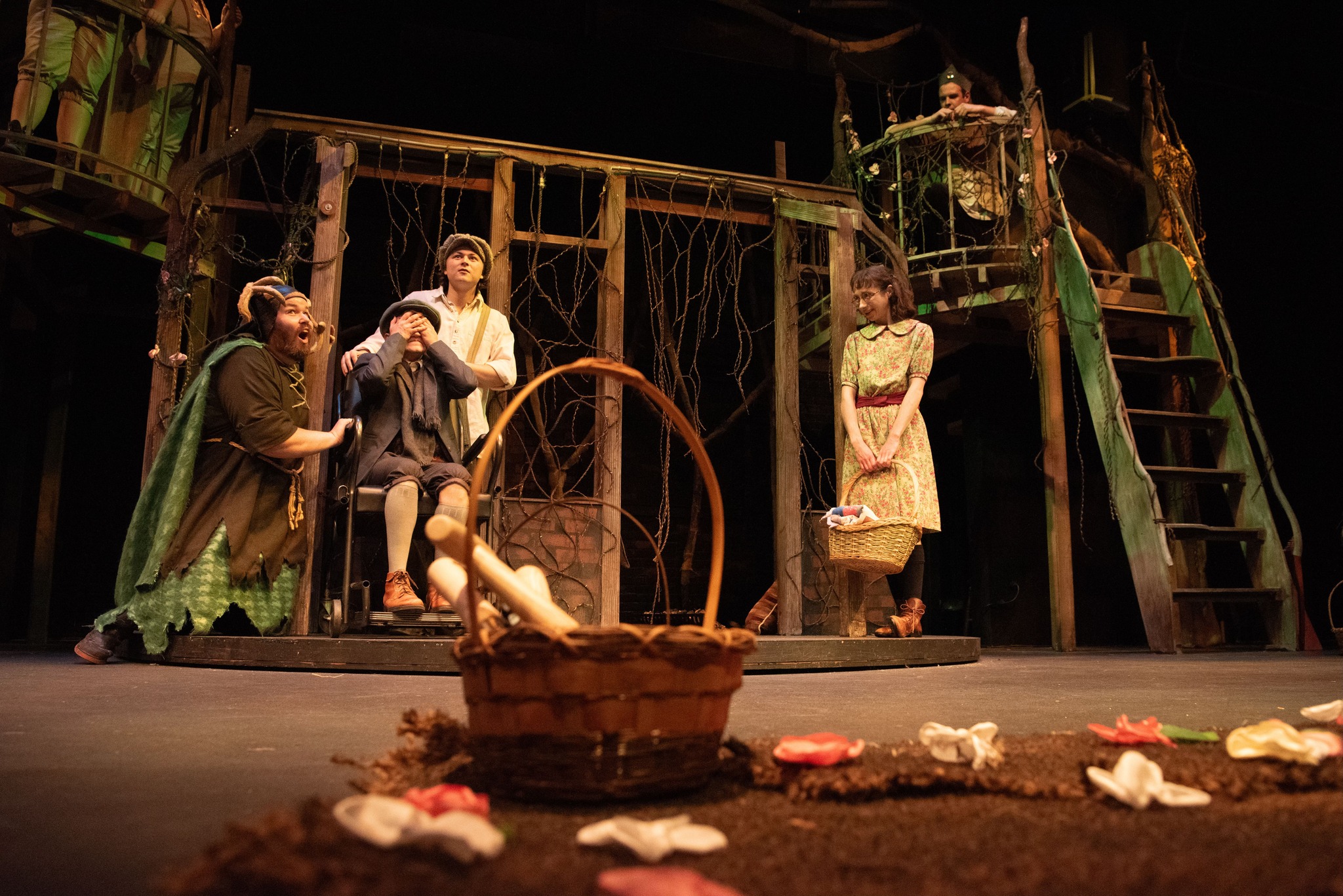
Kyle Gillis as Ghille Dubh, Jack Oliver Kotanen as Colin, Mackenzie Wojcik as Dickon and Katie Ready-Walters as Mary
In the World Premiere of Andrea Boyd’s adaptation The Secret Garden of An Sìthean from the 1911 novel by Frances Hodgson Burnett Boyd takes the action of the story from Misselthwaite Manor in Yorkshire and transplants it to Inverness, Cape Breton Island to a place called An Sìthean, or The Fairy Mound, nestled into a world of the “wild folk” and Gàidhlig ceòl agus cultar: music and culture. This beautiful production plays at Festival Antigonish’s Bauer Theatre until August 23rd.
The story of The Secret Garden of An Sìthean follows the novel very closely. Mary Lennox, played by Katie Ready-Walters, is born in Colonial India to wealthy parents who heavily rely on their servants to take care of her. She is spoiled in that she is not required to lift even a pinky, and she has every extravagance in clothes, toys, and books at her disposal, yet she is completely staved for parental love and companionship with her peers. When she is ten years old her parents die of cholera and she is removed from life as she knows it and is brought to Inverness to live with her equally wealthy uncle Archibald Craven, played by Kyle Gillis. Archibald’s wife Lilias (Jessie Walker) died in a tragic accident in her special garden, and he is still very deep in the throes of grief- so much so that he has had both her garden and their own son, Colin, locked away for the past decade partly because he cannot handle the memories they unleash in him of happier days. Colin, played by Jack Oliver Kotanen, believes that he is doomed to die tragically from a mysterious long-lasting ailment that he was born with. When Mary arrives at An Sìthean she has to first learn how to be independent, but when she finds both her aunt’s overgrown garden and her strange cousin, the magic of both the wild folk and her inquisitive spirit begins to bring the manor to life.
I really liked that woven into the beginning of the story the Gàidhlig wild folk, Scottish faeries, speak of the Pugulatmu’j, the Mi’kmaq “little people,” as the original “wild folk” of this land, with the insinuation that when the Gaels came to Cape Breton, many fleeing the Highland Clearances, they brought some of their wild folk with them.
Katie Ready-Walters plays Mary Lennox, a remarkably straightforward, confident ten year old who is dour, fatalistic, and awkward around others- usually standing leaning away from folks because she has grown up so isolated from any kind of love, affection, or even kindness. She is also incredibly self-aware, and believes that if others don’t like her that must just be the way the world works. When she arrives in Inverness she learns that on the surface it isn’t very different from her life in India. Her Uncle Archibald wants no more to do with her than her parents did, and she is under the charge of the brisk and efficient Mrs. Medlock, played impeccably by Martha Irving, who sees her as just another inconvenience. One difference, however, is that instead of having an Ayah, an Indian Nursemaid who does absolutely everything for her, she has a warm, bubbly maid named Martha, played by Jessica Rose, who strives to teach Mary how to look after herself and, in effect, how to be a ten year old child. Martha softens Mary’s heart, but it isn’t until she meets robin redbreast, pupeteered by Liam Oko, that she feels as though, perhaps, she might be likeable after all. Ready-Walters does a beautiful job of pacing this evolution in Mary- when she smiles her entire face lights up dramatically, but her inherent discomfort in the company of others and matter of fact nature remains constant in a way that feels very realistic given both Mary’s tragic circumstances and her own personality traits.
Similarly, when we meet Colin Craven, played by Jack Oliver Kotanen, a boy who shares both Mary’s genetics and spoiled, isolated upbringing, we see an immediate similarity between the two children. Kotanen plays Colin as petulant and ruled by fear, but also with a similar straightforward confidence as Mary. Conversely, Jessica Rose’s Martha, Mackenzie Wojcik’s Dickon and their mother, played by Natasha MacKinnon, represent all the loving easy affection and warmth of a large working class family. I would be interested in knowing whether Hodgson Burnett based her Sowerby family on Charles Dickens’ Cratchits because they are very much a similar vibe: in stark contrast to the callous upper classes who prize wealth over everything here is the jolly tight-knit working class family who know that love is all the wealth they need.
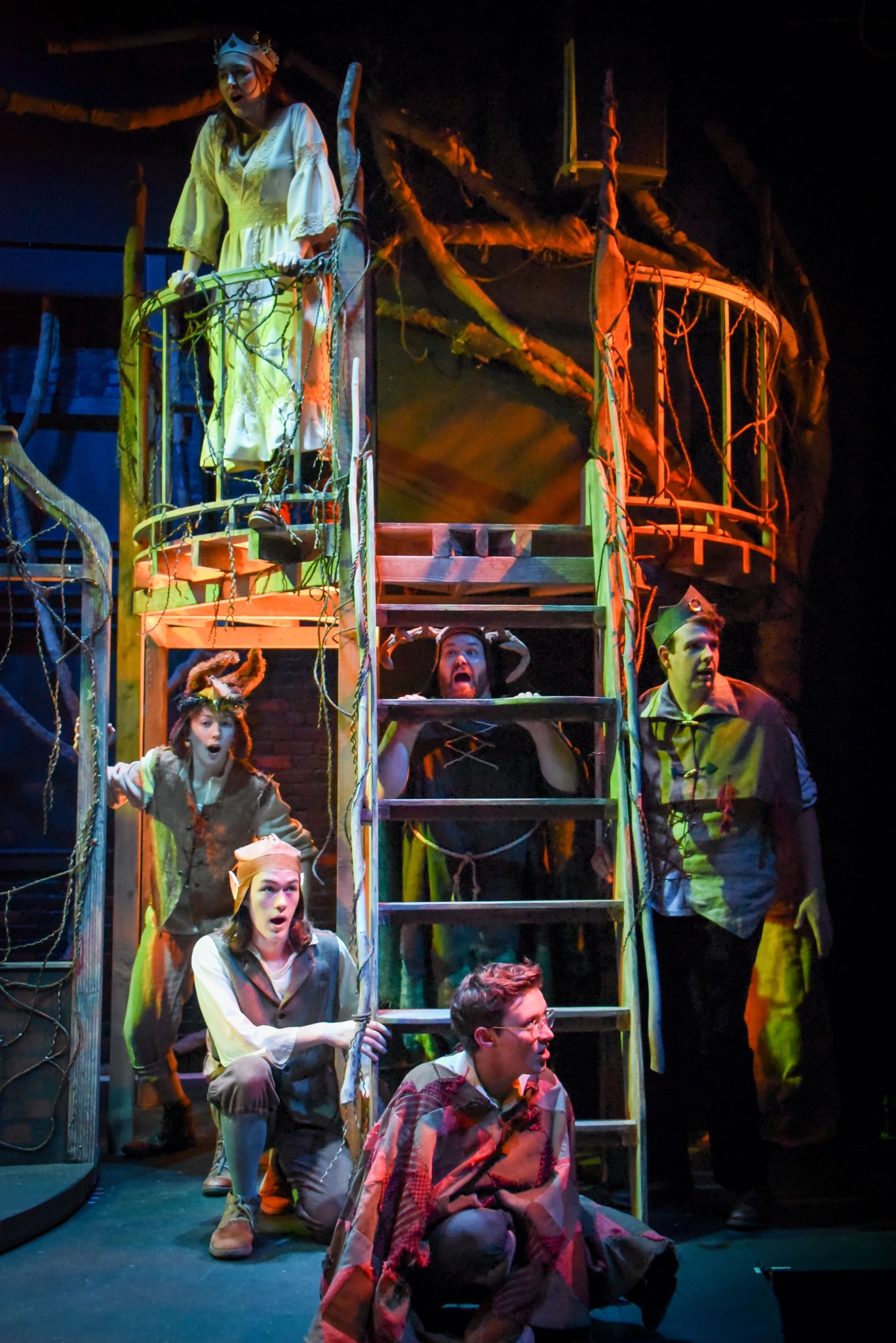
It is the wild folk who help to lure Mary into the garden, and who point her in the direction of Colin’s bedroom, because they too have been impacted by the deep sadness at the manor, and their magic alone hasn’t been able to keep the love and the natural world beyond the walls alive. The wild folk also serve as narrators for the bits of the story that are difficult to depict onstage. Jessie Walker plays a mischievous cat faerie princess that Mary can’t see, but who interacts with her by messing up her bedclothes and making biscuits to comfort her when she’s alone at night. The young children in the audience on Saturday were absolutely enchanted by the whole play, but especially loved the cat.
In between most of the scenes there is Gàidhlig music (musical direction by Meredith Zwicker), led by the Wild Folk, which we see as being connected to the idea of the garden being beò, or alive. “He Mo Leannan” and “Seinn o” are both used as repeated refrains. The former is a waulking song, traditionally a song sung by a group of women while they were fulling cloth. They would rhythmically beat the newly woven tweed or tartan against the table to felt it and shrink it so it would become more waterproof. They would sing songs like “He Mo Leannan” as a way to entertain themselves amid the monotony of their work, but also to keep the beat. “Seinn o” is in the tradition of port a beul, intended to accompany dancing. It likely came from after the British banned the bagpipes in 1745 and the Scots started to write light, improvised lyrics peppered with nonsense words to keep the old melodies of the tunes alive. The waulking songs and port a beul have remained vibrant aspects of Cape Breton culture to this day. The ensemble also play instruments, including the fiddle, guitar, bodhràn, mandolin, and upright bass. In this way, it isn’t just the garden that Mary falls in love with, but slowly she embraces her own culture, one that she was completely severed from when she was in India.
There is also Gàidhlig peppered into the conversations between the Cape Breton characters. Martha, Dickon, and the gardener Ben, played by Wally MacKinnon, go back in forth between speaking English and speaking Gàidhlig, and often use Gàidhlig when they are muttering things to themselves. I thought it was interesting though that the Gàidhlig isn’t used to denote class here, as Kyle Gillis as Archibald sings a beautiful rendition of “Chì Mi Na Mòrbheanna“, and indeed, it is this moment of connection with his roots that begins to heal his own broken heart. Archibald doesn’t speak in Gàidhlig, however, which suggests that there may be the beginnings of a divide in Inverness between those who are fluent and those who are not. Both Colin and Mary pick up Gàidhlig words and phrases the more time they spend with the Sowerbys, suggesting that it is not just the garden that is beò but the language as well.
This adaptation of The Secret Garden is beautiful and very poignant. Setting the story in Nova Scotia adds a cultural layer that isn’t as rich or obvious in the original novel, and of course, there is something very empowering and bold about transplanting this very English story to a very Scottish setting. Katrin Whitehead’s use of levels and stairs in the stage design works really well to give you a strong sense of the interiors of this manor. I loved the way that the characters used dancing in a circle, encircling Mary, and then Colin, as a metaphor for the way that they slowly become embedded in the family, in the community, and in their language and their music. The Movement Direction is by Alexis Milligan.
I found this production to be very touching, and I was surprised how moved I was by the ending, even as someone who is very familiar with the story. It was a real cozy afternoon treat that filled my heart right up. Tha mi cho toilichte. Is toil leam a’ faicinn Ghàidhlig air an àrd-ùrlar. Tha mo chridhe cho làn.
Festival Antigonish’s world premiere production of The Secret Garden of an Sìthean, adapted from Frances Hodgson Burnett’s novel and directed by Andrea Boyd, plays at the Bauer Theatre (4130 University Avenue, Antigonish) until August 23rd, 2025. Performances run Tuesdays to Saturdays at 7:30pm with a 2:00pm matinee on Saturdays. Tickets range in price from $30.00 to $45.00 (based on the patron’s age and seating preferences) and are available online here, by calling 902. 867.3333 or in person at the Box Office at 4130 University Avenue. August 1st is a PWYC preview performance. There is a relaxed performance on August 16th. The Bauer Theatre is wheelchair accessible and for more accessibility information please visit this website.