
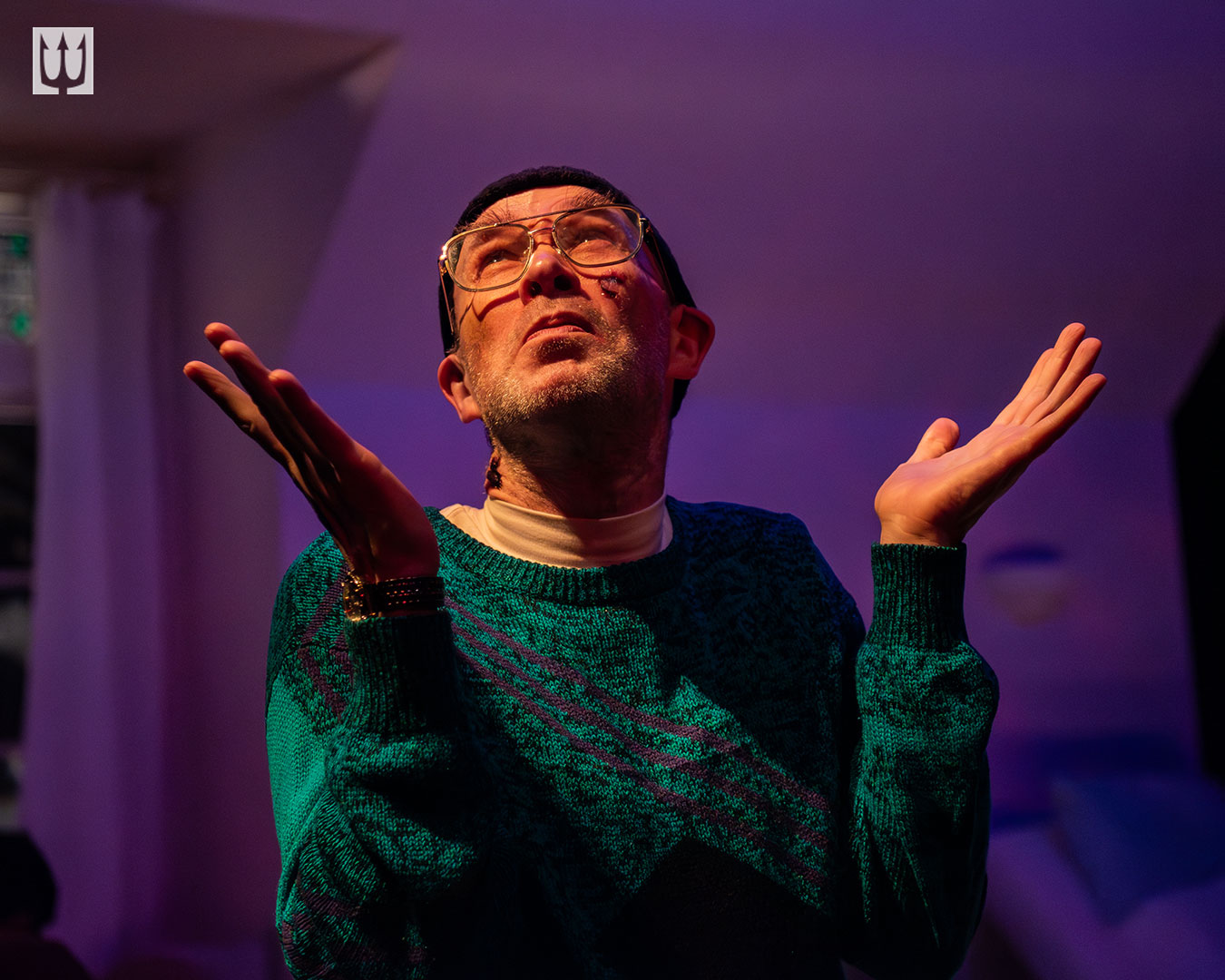
Garry Williams as Thomas. Photo by Stoo Metz.
Imagine that it is October 19th, 1991 and you have just been told that in a week Princess Diana will be coming to visit the place where you live. For most folks this news would be met with a feeling of blind faith and assurance that you would be meeting the Princess. At the Casey House, however, the AIDS hospice where Nick Green’s play Casey & Diana (now playing at Neptune’s Scotiabank Studio Theatre) takes place, this is not necessarily so. The patients who live here are all dying, and rapidly. Thomas, who has been there the longest, is extremely sick. Holding on for seven more days to meet the Princess is a formidable task. But the news buoys him. He is inspired to try to hold on to every millisecond he has left.
Andre is younger than Thomas and just arrived, but he is also dangerously ill. Thomas has worked hard to build a community among the patients, rallying folks for walks, and bossing every one around during his spurts of exuberant energy. Andre is completely isolated. No one knows that he is here, and we get the sense as well that no one even knows that he is dying. Marjorie is a new volunteer at the Casey House, who has recently lost her best friend to AIDS. She sees Andre’s loneliness and wants to be able to fill the void. To complicate things even further, just as Thomas hyper-focuses on Princess Diana he gets an unexpected visit from his sister, Pauline, who basically ghosted him when she heard his diagnosis. Now Thomas has to confront his feelings of rage, grief, hurt, and betrayal that he had been able to suppress better before she arrived. In the middle between Thomas and Pauline, and in between Andre and Marjorie is Vera, a nurse, who has to keep the best interests of her patients at heart, even when they may seem counterintuitive, which means enforcing hard boundaries, and navigating the truly complex waters of familial relationships in crisis, often mired in homophobia.
Nick Green has done a lot of research to create such a rich and nuanced environment. Each one of these characters is richly complex, and in Pauline and Marjorie especially we see such a beautiful mixture of them being problematic, but also, I think, easy to emphasize with and likeable. Thomas seems to be in his 40s, and even though it is not spoken about a lot we do have the sense of someone who was born in the 1930s or 1940s, who had a childhood where he wasn’t allowed to be himself, but whose adulthood was marked by this steady, slow series of progressions, which allowed him to come into himself, and be himself openly and unapologetically, and then the grief of all of that, in the last decade or so, coming crashing down so violently again. Andre, conversely, is so young we see that he hasn’t gotten the breadth of experience of Queer community and culture that Thomas had. In both cases we are struck by how profoundly unfair these circumstances have been.
In Neptune Theatre’s production of the play, directed by Richie Wilcox, Vera is played by Koumbie, and we register the exhaustion, emotional likely even more than physical, and the sadness beneath the surface, but shining most of all is her professionalism and her kindness. She needs to be firm with Marjorie and with Pauline; she needs to protect her vulnerable patients above all other considerations. Susan Stackhouse plays Marjorie, just as exuberant in her excitement as Thomas is about Princess Diana in the way she tries to bathe the Casey House, and Andre’s life there in particular, in metaphorical sunshine and rainbows. She is adamant, even in the face of Vera’s resistance, that their spirits must not be broken at any cost. In many ways, this sounds like the answer, but, we see that the reality is more complex. Stephanie MacDonald plays Pauline, who has a history of not just loving and supporting her gay brother fiercely, but who lived fully in his Queer life, among his Queer friends. It’s not clear whether she herself is also Queer, which is also true for Marjorie, so Pauline’s choice to distance herself from Thomas when he was diagnosed with HIV isn’t about a hatred of Queer people, but an inability to confront the reality of her brother being deathly ill, and also a fear of the virus spreading through touch, despite the fact that the science in 1991 didn’t support this. When she re-enters Thomas’ life she is bringing all her own baggage to his doorstep, navigating her own guilt and also denial. Thomas doesn’t need any of this in this moment, but is it worth dealing with to reconnect with his sister? Koumbie, Stackhouse, and MacDonald each bring out all the multifaceted aspects of their characters with brilliant ease.
The play doesn’t unfold in chronological order, so Rebecca Gibian almost floats in and out of the world of the play as Princess Diana, really capturing not just the way the Princess spoke, but also so much of the physicality of dignified strength mixed with humility and warmth that people found so captivating about her. Playing characters based on real people is always difficult, but this must have been an extreme challenge for both Gibian and director Richie Wilcox to walk the line between portrayal and imitation, and keeping audiences from being distracted from the story by any of the choices they were making to evoke such a beloved person, who is also a tragic public figure in her own right.
Alex Wierzbicki plays Andre as someone who is so shell shocked by his circumstance, he’s basically shut down. We see him come out and then retreat back into his shell in a way that beautifully contrasts with Thomas’ boisterous expressiveness. Garry Williams plays Thomas and it’s a truly mesmerizing and heartbreaking performance. Williams oscillates so smoothly between extreme highs and extreme lows, through absolute clarity and brain fog, showing us both so much of who Thomas was as a healthy, younger person, but also so much about how sickness like this changes you and everything. Not one single note of Thomas feels false, and you can see the gentleness and the care that Williams takes in creating someone who, while imperfect, is so poignantly human.
Scott Penner’s set creates a raised platform with a back wall and ceiling, which takes up most of the Scotiabank Studio stage, but not all of it, and within this cosy space is a very realistic backdrop of Andre and Thomas’ bedroom at the Casey house. The most magical is the back window where Leigh Ann Vardy’s lighting design allows you see the progression of the days and nights in June shining into the room. We get such a clear divide through that window of the reality in here, versus the reality of life in the Village in Toronto happening outside. In front of the raised part of the stage doubles as both the more administrative side of the Casey House, and the neighbourhood outside where Thomas is still able to venture a bit with his sister. It’s interesting how the world outside the bedroom is more imagined and inferred, while the world of Andre and Thomas’ bedroom is much more concrete kitchen sink realism.
I was so impressed by Diego Cavedon Dias’ ability to dress Gibian’s Diana in a way that looked authentic. The tailoring and the cut of her clothes, the way she wore her hat, it all made her look like the proverbial million bucks. I also have to give a special shoutout to Marjorie’s track suit that looks like it was straight out of Northern Getaway. There was never any doubt that we were hovering around the transition between 1980s and 1990s fashion.
When Princess Diana visited the Casey House in Toronto on October 25, 1991 I was four days away from turning seven. My mother, who worked in Public Health for the Provincial Government, would explain HIV to me a few days later, in November, when LA Laker basketball star Magic Johnson announced his retirement from the sport in a press conference she was watching while we were both in the same room. I remember asking her if Magic was going to die.
It’s 2025 and Magic Johnson is 65 years old, and the Casey House in Toronto is no longer a hospice it is now a speciality hospital for people who are living with or at risk of HIV. Casey & Diana reminds us of how devastating and horrifying it was to have a new disease ravaging through marginalized communities and being met with inaction, denial, and disinterest at nearly all levels of government world-wide. We continue to see how epidemics and pandemics disproportionally affect marginalized communities, and how destructive fear can be to common sense and empathy. Princess Diana was the antithesis of this in Toronto in 1991, and this was one of the ways that she inspired people the most profoundly during her own short life- to lead with your heart and your humanity- not your judgement and your Anxiety.
Even with all the scientific and cultural progress we have made regarding HIV and AIDS, this play could not be more relevant in this moment.
Casey & Diana plays at Neptune Theatre’s Scotiabank Studio Theatre (1589 Argyle Street, Halifax) until May 18th, 2025. Performances run at 7:30pm Tuesday to Saturday, with 2:00pm matinee shows on Saturdays and Sundays. Tickets range in price from $33.00-70.00 based on seating. Tickets can be purchased online here, by calling 902.429.7070 or in person at Neptune Theatre, either at 1589 or 1593 Argyle.
Run time is approximately 2.5 hours, including a 15 minute intermission.
Please note, this show contains: Strong language, realistic depiction of epileptic attack, medical needle use, brief depiction of blood, & discussions around death and dying.
This show is recommended for ages 12+
Key Performances:
Talkback
Thursday, May 1 – 7:30 PM
Masked Performance
Sunday, May 4 – 2:00 PM
Neptune Theatre is fully accessible for wheelchair users. Neptune offers hearing-assistance devices, along with their masked performance and audio described performance. For more Accessibility Information Click Here.




1 thought on “Garry Williams is Magnificent in Casey & Diana at Neptune Theatre”
Comments are closed.