I wasn’t sure what to expect from Mauro Mueller’s film 111 Echoes from Halifax, which is about the Swissair crash of Flight 111 off the coast of Peggy’s Cove. I was thirteen years old on September 2nd, 1998 and about to start Grade 9. Between the Swissair crash in 1998 and the September 11th attacks in 2001 to this day airplane crashes are among my biggest anxiety triggers. What I remember about that time in 1998 was my friend, whose house is on the ocean, coming into school later that week having seen parts of the rescue operation that turned into a grisly recovery effort out on the water. I was curious about what angle the filmmakers would chose for telling this profoundly sad story, and Mueller and Jennie Allen have written a fictionalized story that creates a rich and complex tapestry of just some of the lives from three different countries that were forever changed the day the remains of Flight 111, which left from New York City en route to Geneva, ended up here in Halifax, a city with a long history of rising to such a somber occasion.
I was relieved that there are not any scenes in this film that dramatize the plane crash from the passenger’s point of view- that was my biggest fear heading into this screening. The film opens in a cozy home in St. Margaret’s Bay- a fisherman and his daughter are dancing to Buddy MacDonald’s “Getting Dark Again-” it’s an idyllic portrait of life in Nova Scotia. Then they hear the loud plane engine, and they immediately know that something is wrong. The father rushes out to his boat to help. His daughter, who is an older teenager or very young adult, chases after him, resolved to come too. Within moments in the film they are huddled together sitting down in their boat, traumatized by what they have seen in the water. We in the audience don’t even know their names.
The action then moves back in time, and we are in New York in the home of a young man named Jacob (Wiljo Martin) who is about to embark on an incredible adventure in Switzerland. There is tension in his household around his leaving. His mother, who we gather is home a lot and is very close to him, is excited for him to spread his wings and see the world. His father, Saul, who is a surgeon, doesn’t want him to leave, although it’s a little vague why he feels this way- beyond him projecting his own fear of flying onto his son. What is clear is that Saul works a lot and is panicking a bit at the sudden realization that Jacob has grown up, and he actually doesn’t know that much about him, and they aren’t connecting in the way that he wants to. We then travel to Switzerland where we meet Louise, who is about Jacob’s age, and she is on the telephone with her mother, who is at the airport in New York where Jacob is headed. Louise is very upset because her mother has left her home alone with her new stepfather who she despises. We then move to the airport in Geneva where a Swissair worker, Carine, is scheduling the flight crew for Flight 111, among other flights, and also balancing a heavy responsibility at home- her husband is in a nursing home with dementia, and he has become cruel and hostile to her. These scenes are also presented to us in three different languages- English in New York, French in Louise’s house, and German for Carine.
Saul is just finishing with a patient late at night when he sees the breaking news about the plane crash. He has to go home and tell his wife that their son, who was just there so young, bright, and alive, is gone. In their pain they splinter away from each other, and away from their younger son, who is just a little boy. Saul has to go to Halifax in search of answers, and he has to go alone because his wife refuses to engage with any of these pragmatic realities. Louise and her stepfather both head to Halifax too, although they are also barely speaking to one another. Carine gets sent to Halifax by Swissair as a liaison between the victims’ families and the airline. She has barely been trained for this sort of work, dealing with family members in the throes of sudden and profound grief, and she is flying by the seat of her pants trying to help. In Halifax people have rallied to help in whatever way they can. Fishers have gone out with nets to collect whatever they can collect out of the sea. People are opening up their homes to the victims’ family members to stay, they’re helping to organize places for press conferences, for debriefs for the family, for the early stages of the investigation, as well as opportunities for family members to memorialize their loved ones in some way while they’re here.
Once here Saul, who feels displaced from his entire family now and is angry at Jacob having left him when he so vigorously tried to convince him to stay, connects with Carine, who is feeling extreme guilt over her association with the airline, and especially having booked in her friend to work as part of the crew on the flight- and having booked everyone in to be on the flight. She is also at a loss at what to say to the family members, but she is determined to try. She sees how lost and aimless Saul is, in unfamiliar surroundings, alone, under these horrific circumstances, and she makes him a special priority. Being so alienated from her own husband, Carine is in some ways just as vulnerable as Saul. She also begins to establish an intense and nearly immediate love affair with Nova Scotia. Louise, too, is aimless and lost- a frightened child without her mom, who is rejecting the care from the only person she really has left to take care of her.
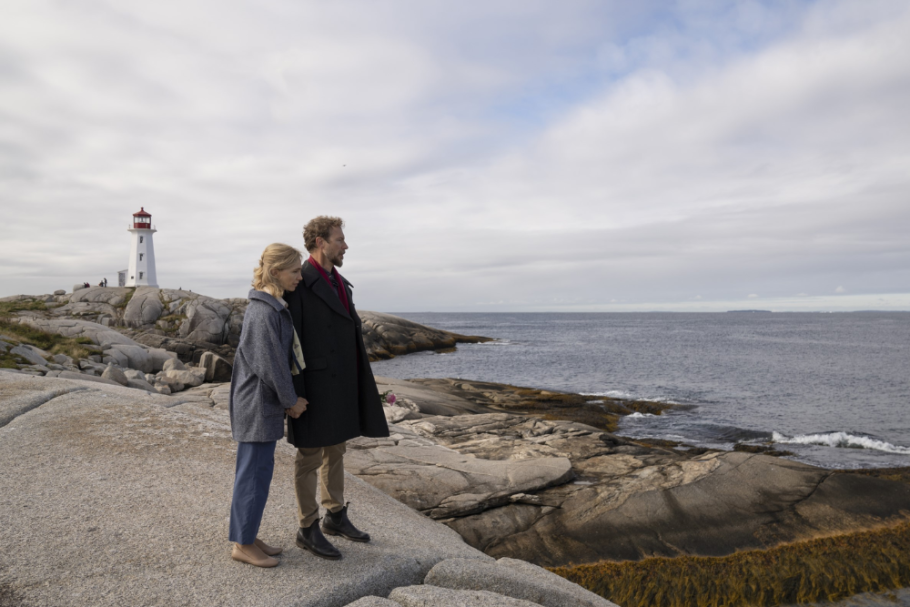
Once they have done what they came to Nova Scotia to do Saul, Louise, and Carine go back to their shattered lives, and yet, as more and more time goes by the each realize that they have unfinished business at Peggy’s Cove, and they all return there. The film from there shows how they each are struggling to find any meaning left in their lives, to find a way to connect, to find a way to live with this grief.
Jennie Allen and Mauro Mueller have done a beautiful job of creating vivid storylines here that feel authentic to what the experiences could have been like for the real life counterparts of these characters. While Saul and Carine are certainly drawn to each other within the heightened emotional roller coaster of their times together, I’m glad that Allen and Mueller resisted the urge to create a Nick and Diane storyline here. Mueller, as the director, keeps most of the focus in the film on a wild disparity between both the visual idyllic beauty not just of Nova Scotia, and Peggy’s Cove specifically, but also Switzerland, and the gruesome reality that these poor people have been thrust into. Yet, there are few moments where he offers us a bit of a poetic metaphorical lens too- as we see Saul literally drowning in his grief. There is also a fantasy moment between Saul and Carine where they dance, as though both are wishing they could escape to a completely different dimension. There is also a whale, which I think for Nova Scotian audiences might be jarring because we know how unlikely it is to see a whale breach like that so close to Halifax even in an entire lifetime of living here, but it is supposed to represent a sign, and perhaps the more improbable the whale the more it is suggestive that there is something magical or mystical about it. I was also curious to know a smidgen more about Saul after he left Nova Scotia for the second time. Was he able to reconnect with his wife, or was the loss of Jacob too much for the both of them?
The actors do a great job at creating these nuanced relationships with one another. Kris Holden-Ried as Saul begins his journey as someone who is extremely closed off and angry, but as the film progresses he becomes more and more soft, gentle, and open, and yet you never get the sense that his grief has at all lifted. Ursina Lardi, as Carine, creates a great sense of nervous energy, of someone who is walking on eggshells- afraid of saying or doing the wrong thing and making someone already having the worst days of their lives experience any more pain or suffering. Carine finds tranquil moments at a restaurant in Peggy’s Cove that becomes integral to her future. Fathia Youssouf’s Louise was the character that I related to the most. As an only child of a single mother myself, my biggest fear was losing my mom suddenly like this, and Louise responds in exactly the way that I would have- in chaotic lonesome despair. Natalie Brown plays Jacob’s mother, and her grief mirrors Louise’s in her inability to be rational, to be anything but a profoundly wounded mother- even in the face of her younger child who is begging to be parented.
There are two things that strike me as a Haligonian watching this film. The first is the scene where the family members are looking through carefully recovered and catalogued personal items belonging to the victims, and it reminded me of how John Henry Barnstead developed a meticulous method of organizing, cataloging and preserving the personal effects of the Titanic victims who were brought to Halifax in 1912, and how his method was used again in the aftermath of the Halifax Explosion in 1917. The people here know how to do this difficult and somber work, and I am sure that Barnstead’s methods were in full force again in the respectful and careful ways that the victims’ personal effects were cared for. It is such a strange and macabre thing for a city to be recognized for, but at the same time it is fortunate that Haligonians were able to offer these families this kind of expertise at a time when recovering special pieces of jewelry and other heirlooms was deeply important for folks.
Secondly, while it feels wrong to compare two different disasters to one another, and this film doesn’t really dramatize Saul and Louise staying directly with locals, in real life Haligonians did host the family members of those who had lost their loved ones on Flight 111. This, of course, reminds me of those who, famously now, were hosted in Gander (and here in Halifax too) after 9/11, that have been so widely praised and literally sung about. I don’t mean to imply at all that Operation Yellow Ribbon wasn’t everything Come From Away claims it to be, it was an amazing initiative deserving of accolades, and Heritage Moments, and deep respect. This film did strike me, though, because it reminded me that while of course those who were stranded in Canada on 9/11 were terrified, and panicked, and some did have direct connections to the terrorist attacks, most of them were, at the core, incredibly lucky folks who survived being in the air that day. In contrast, the folks who came here in September of 1998 were traumatized, grief-stricken parents, partners, and children of people who died in a tragic, horrific event. For the people here who hosted these folks it wasn’t just about providing shelter and kindness, it was about having to offer some level of grief counsel that most weren’t trained to provide. They had to lead with a level of empathy, care and tenderness and wide open Nova Scotian hearts just trying their best to give these grieving loved ones a soft place to land. I don’t think the people in St. Margaret’s Bay get enough credit for the way that they have become stewards for all 229 people who died in the crash, and the depth of generosity and selflessness that was one display here in 1998. The film made me feel very proud through my tears. Six thousand people in Nova Scotia sought counselling after the crash, according to Stephen Kimber who wrote the book Flight 111: The Tragedy of the Swissair Crash.
The film ends in a very poignant way, but also quite haunting, as it shifts its focus for a moment back to those who were on the airplane as we see them waiting to board at the gate- a completely mundane scene of people waiting, as people do every day, completely oblivious of what the future holds for them. We see Jacob, we see Louise’s mom, we see kids with their parents, and it’s devastating. I was very glad to have seen this film, not just because it is a moving story, but even more so because it’s given me a deeper understanding of how profoundly this event has shaped the lives of so many people here, and how it has forged a relationship between Nova Scotia and Switzerland that I didn’t know about before. Like those who perished aboard the Titanic over a century ago, I know the victims of the Swissair crash will continue to be remembered and honoured by the folks here in whatever ways we can, as that is Nova Scotia’s way.
111 Echoes from Halifax will next play at the Zurich Film Festival, and will be available in cinemas across German-speaking Switzerland from October 1st.