
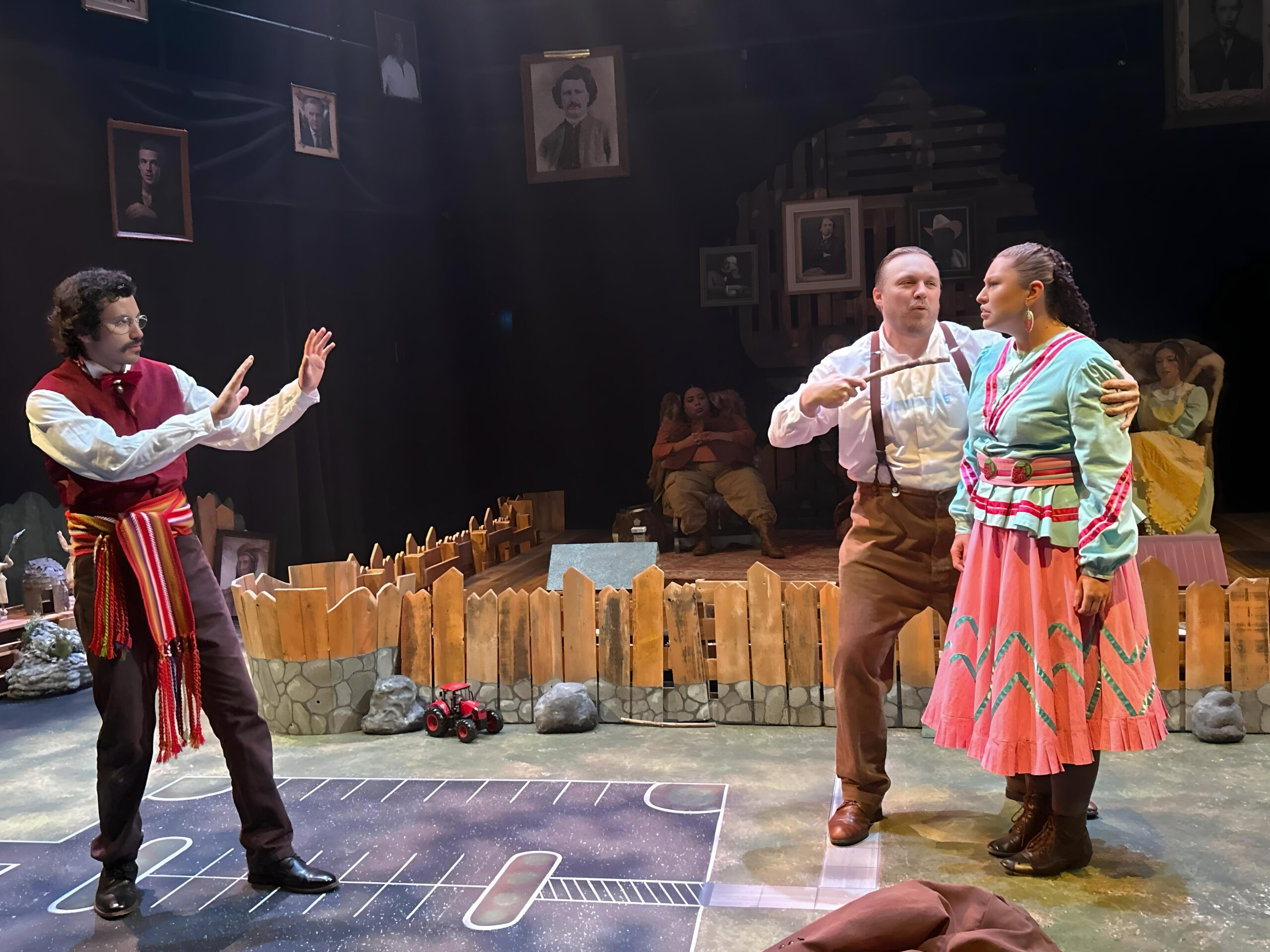
Elliot Gosh as Louis Riel, Eli Ham as Thomas Scott and Danelle Charette as Marie Angelique
Frances Končan’s play Women of the Fur Trade, directed by Keith Barker, opened September 25th, 2026 at Neptune Theatre co-presented with Prismatic Arts Festival. It runs until October 11th on Neptune’s Scotiabank Studio Stage. I sat down with cast members Danelle Charette, who plays Marie-Anglique, and Elliot Gosh, who plays Louis Riel, at the Media Call to chat about the show.
This production comes to Halifax from Thousand Islands Playhouse in Ontario where it ran last May. Danelle Charette was born and raised in Regina, Saskatchewan, on Treaty 4 Territory, but has been based in Toronto for the last seven years since graduating with a degree in Performing Arts there. “I’ve done theatre my whole life,” she says.“I’ve been working professionally for the last five years, and it’s been really wonderful. I do predominantly Indigenous plays, and in the development of new Indigenous work.” Like her character, Marie-Angelique, Charette is also Métis.
Elliot Gosh is originally from Victoria, British Columbia, and he went to drama school at the London Academy of Music and Dramatic Art (LAMDA) in London, England. “That was sort of my introduction to theatre in a lot of ways,” he says. “I got thrown into the classical theatre world, which was an incredible experience, and gave me my foundation for craft, which is something that’s become very important to me.” He moved to Toronto last year where he met Keith Barker, the director of this piece, and that’s how he got the opportunity to play Louis Riel.
Gosh stresses that while his character, of course, is a real person from Manitoban and Canadian history, Women of the Fur Trade is not a history play. “I think Frances has done an incredible job of taking creative liberties in terms of telling a story that you wouldn’t normally get to see, that you would never see in a history book, but still honouring these historical characters and getting to bring them to life. Louis Riel was this emblematic figure from Canadian history- standing up to a government that did not recognize his people, their rights, their lands. So, that sentiment, I believe, is still very strong within this play and this character. He’s on the precipice between standing up and fighting for his country, and also trying to live life as a man in love.”
The historical context for this play surrounds what is known as the Red River Rebellion. The brand new Canadian government bought a territory known as Rupert’s Land from the Hudson’s Bay Company on December 1, 1869. This territory under the Hudson’s Bay Company had existed for over 200 years. When English speaking governor William McDougall sent out surveyors to plot the land so that it could be sold to Protestant settlers from the East or English speaking newcomers the Métis population who lived on these lands prevented McDougall from entering the territory and set up a provisional government. Louis Riel negotiated directly with the Canadian government to establish Manitoba as a Canadian province. There were resisters to this provisional government, including Thomas Scott, an Orangeman who joined the Canadian Party, a group of Protestants who advocated for the annexation of the Red River Colony by the Canadian Government, and encouraged the idea of these lands being given to Protestant settlers from Ontario. Thomas Scott is also a figure represented in this play, played by Eli Ham.
“I think we get to see a beautiful relationship between Louis Riel and Thomas Scott, which of course is something that we wouldn’t have seen in the history books,” says Gosh. “It opens up a purview of what their relationship possibly could have been like if those two people had met. Louis Riel is a complicated figure in history, and there’s these dreams of grandeur that he’s so drawn towards, and then the hope for building a better future. He comes to odds with what to do and how to do it. I think that ends up being a challenge.”
“My character is Marie Angelique. She’s very bold,” says Charette. “She would say that she’s not like a proper lady. She has too many opinions. She is a Métis woman who has faced the laws of the Canadian government. She is a survivor of the school system, and she’s navigating her identity as a Métis person in a country that did not acknowledge any identity. I think a big part of her trajectory and her interest in Louis Riel is that there’s somebody the same as her that is fighting for the cause that she believes in, and that’s a huge part of her. She wishes that she had the power to go out and be a man, or be a woman in a man’s world. I think that’s her trajectory, her story, and her wanting to meet him. She’s in love with him, but at the same time, I think she wants to be him at the same time…. As a Métis person myself it’s such a privilege and an honour to play a role like this. This is [my ancestors’] story. It’s real. They suffered a lot of shackles and trauma from the government not acknowledging them, and so to be able to have a voice to be able to tell this story, Frances has done such a wonderful job in sharing it with the world. I feel so lucky to be part of it.”
There are two other women in the play who also live inside this fort with Marie Angelique. Cecilia, played by Alison Beckwith, is the British settler, and she is married and raising children there. “She’s navigating what it means to know these two Indigenous women in a fort where they’re her only friends, and trying to follow a government that is predominantly made for her, and what that path looks like for her,” says Charette. Eugenia, played by Joelle Peters, is an Ojibwe character who is the only one of the women who is allowed to leave the fort. “She’s a bit braver than the other two. She has a lot more life experience, but she is the calming of the storm. She kind of is the big sister role, and the knowledge keeper between all of them of the outside world,” she says.
The fort is based on Fort Garry, a Hudson’s Bay Company trading post, in what is now central Winnipeg. It was established first in 1822 and then rebuilt in 1836. It served as the centre of the fur trade within Red River Colony. “[Eugenia] is the one that’s going out to hunt and trap and trade and carry on all those Indigenous traditions up until this turning point in our story, which is Confederation, where those rights were taken away,” Charette says.
The play begins with the three women of the fur trade playing a game where they recite quotations and have to guess which great man has said each one, and these transcend time and place, allowing these three women to live with one foot in the past and one foot in the future.
Charette says, “[Končan’s] voice is so present throughout… she’s a pop culture fiend, so that’s where all these contemporary ideas come from. I think it also offers the audience a chance to hear some really devastating history that we often ignore, while having a light, contemporary light to it, and lots of humour- things to make people laugh, so that it’s easier to digest.”
“I think it’s so important to have humour as a path to a darker history,” agrees Gosh. “The world is a tough enough place as it is, bombarding people with dark history in a dark way, it can be morose. I think it’s beautiful the way that Frances integrates comedy into storytelling. Another thing that really stands out to me is that we were fortunate to do this play earlier in the year in the Thousand Islands, and having done a full run of it there, and then coming back to it a couple months later, I think a testament to a great play is something that you can keep working on, and keep making new discoveries, and even as we have been rehearsing in the last week, leading up to our previews and opening here, there’s still discoveries that we’re making in the room that weren’t there before. It’s beautiful being able to find layers that Frances has built into this story.”
“She really connects the past, the present, and the future all into one, which is Louis Riel’s big saying,” adds Charette, “which is an Indigenous saying too- past, present, future. You think of your seven generations. I think Frances, her writing, does that. It offers a little bit of something for everybody. That’s what makes it so delightful to read. She’s built layer upon layer upon layer, so for actors [and audiences] you can never get bored of it… because you’ll discover something new every single time.”
Jay Havens’ extremely detailed set mirrors the text of the play in how it surrounds the characters in layers of history and popular culture that is a feast for the eyes. “There’s so much to discover,” says Gosh, “if you come up and have the chance to look around the stage and look around the set, it’s almost like a little museum piece.” Charette adds that there are miniatures of teepees, and people, Disney’s Moana holding a “Land Back” sign, toys, and tractors. “It really plays into this idea of adolescence, and [Havens] has connected the past, the present, and the future into his set design as well.” She notes that the parking lot in the front of the stage and the tiny Parks Canada sign represents how many of these historic forts are now these historic site museums that tend to appeal to tourists.
“The men are always outside of the fort,” says Gosh, “so they have the freedom to move around the space, so the space itself becomes a distinction between who has freedom and who doesn’t, and that changes throughout the story, as well as in terms of who is allowed out of the fort and who isn’t.” Within the fort the women are surrounded by portraits of men. “[The idea is] that they are being watched by all the men in the world, and there’s many different portraits on the wall- men of the past, men of the present, men of the future- good men, bad men, okay men, but it’s just this idea that [the women] are always being watched, they’re always surrounded, and thought of by these figures that they have no control over,” says Charette.
“If you come and see the show,” she adds, “You might even get to see what’s behind the portraits…. [The Women of the Fur Trade] get to take their power back.”
Frances Končan’s Women of the Fur Trade directed by Keith Barker plays at Neptune Theatre’s Scotiabank Studio Theatre (1589 Argyle Street, Halifax) until October 11, 2026 as part of Prismatic Arts Festival. Performances run Tuesday to Saturday at 7:30pm with 2:00pm matinees on Saturday and Sunday. Tickets range in price from $29.00 to $49.00 based on seating and they are available online here, by calling the Box Office at 902.429.7070 or visiting the Box Office in person at 1593 Argyle Street.
KEY PERFORMANCES
Industry Night
Tuesday, September 29 – 7:30pm
Masked Performance
Sunday, October 4 – 2:00pm
Relaxed Performance
Wednesday, October 7 – 7:30pm
Talkback
Thursday, October 8 – 7:30pm
Content Advisory: This production deals with issues of colonial violence, misogyny, and racism. It contains a sequence of flashing lights, strong language, loud noises, and gunshots.
Neptune Theatre has a range of Accessibility Options for folks (Both Fountain Hall and the Scotiabank Stage are accessible for wheelchairs. Patrons can now purchase wheelchair seats for individual shows online with the promo code WHEELCHAIR. For more information, please contact the Box Office.). Click here for more thorough information.
“The Prismatic Arts Festival is a national, multidisciplinary arts festival that showcases and celebrates innovative work by Indigenous artists and artists of colour from across Canada. Based in Kjipuktuk (Halifax, Nova Scotia), Prismatic has been bringing audiences vibrant, boundary-pushing new works in theatre, dance, music, film, visual arts, media arts, and spoken word since 2008.” It runs until October 4th in venues around the city. For more information about the full lineup of programming please visit this website.
Canadian Theatre Criticism is an essential part of a healthy and thriving theatre community. It helps theatre companies find new audiences for their shows, deepens audiences’ engagement with local artists and the work being created in their communities, and it is one of the best ways to preserve a snapshot of an ephemeral art form for future generations of theatre lovers. TWISI relies on support from its Subscribers, folks like you who care about the survival of local and independent arts coverage. Please consider becoming a Subscriber today, or click here for more information. Thank you so much for supporting TWISI.






1 thought on “Danelle Charette & Elliot Gosh on the Role of the Past, Present & Future in Frances Končan’s Women of the Fur Trade”
Comments are closed.