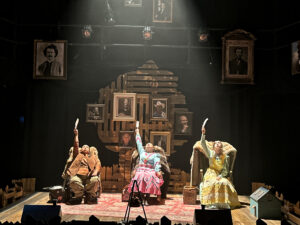
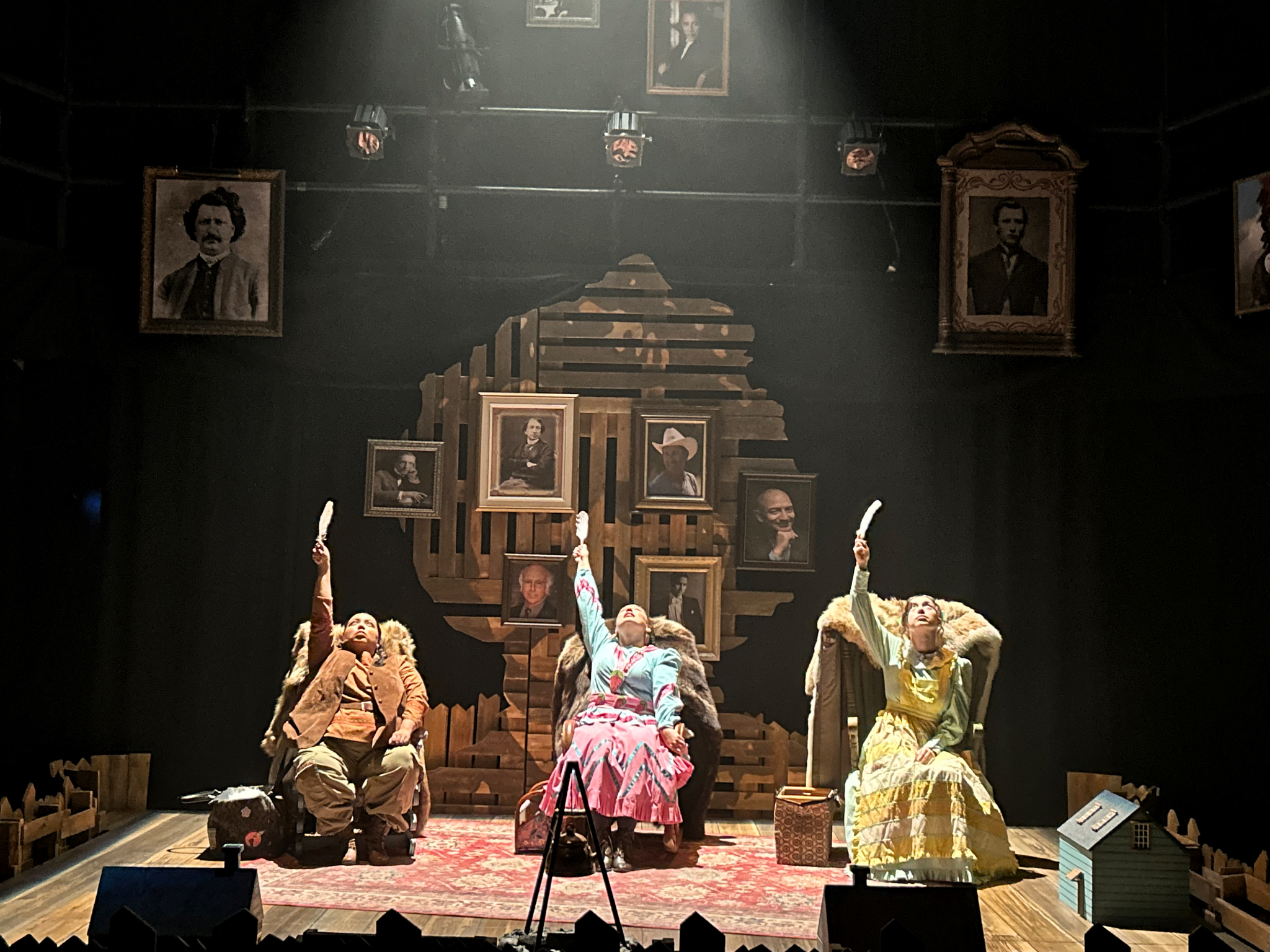
Joelle Peters, Danelle Charette & Alison Beckwith in Women of the Fur Trade at Neptune Theatre
I love to learn about history, especially Canadian history, and my favourite way to delve deeper into history is at the theatre. Frances Končan’s play Women of the Fur Trade, directed by Keith Barker, which plays at Neptune Theatre’s Scotiabank Studio until October 11th as part of the Prismatic Arts Festival is exactly up my alley. After having a wonderful conversation with Danelle Charette, who plays Marie Angelique, and Elliot Gosh, who plays Louis Riel, I wanted to read a bit more about the Red River Rebellion, Fort Garry, Thomas Scott and the Canadian Party for some additional context for the play, and I was really struck by how dense and complex it is, and how Končan manages to capture this depth and complexity in a way that is clear, clever, engaging, and very funny.
We meet three women who live together inside a fort on the Red River in the years just after the Confederation of the two Canadas, Nova Scotia and New Brunswick. Yet, from the beginning it is clear that time in this world is fluid, as the women are surrounded by portraits of men from Louis Riel and Sir John A. MacDonald to Graham Greene and Bob Ross. The language and references throughout the play oscillate between the historic and the contemporary. Eugenia, played by Joelle Peters, is an Objiwe woman who is at the fort’s trading post with her furs to sell or barter to help support her family members who still live on the land further north. Marie Angelique is a Métis woman who feels like her Indigenous mother abandoned her at the fort when she was a child. She doesn’t seem to have a close connection to her French father either, beyond a few words of French that she peppers into her conversation. She is painfully aware that she exists somewhere in between Eugenia and Cecilia, the white settler character, and that she doesn’t quite fit into either experience. Cecilia, played by Alison Beckwith, is the wife of one of the settlers in the Canadian Party, a group of expansionist Protestant settlers who don’t want Sir John A. MacDonald to negotiate with Louis Riel and the other Métis men laying claim to this land, but are advocating that the Canadians just annex the territory by force. Cecilia understands her husband’s point of view without needing to give it a second thought because this is the ideology into which she was born and raised. Yet, now, as she spends her days apart from her husband, only hearing from him by letter, but physically in space with Eugenia and Marie Angelique she is beginning to question what she has always taken as gospel, while also often feeling defensive of her opinions and her place as a white woman in the world.
Eugenia comes and goes from the fort as she doesn’t prescribe to the patriarchal rules that govern Cecilia and Marie Angelique’s understanding of the “proper” ways of the world. Eugenia is also at first skeptical of this new Métis leader, Louis Riel, played by Elliot Gosh, which makes sense because, as his name suggests, most of Riel’s ancestors were French, and the Objiwe had excellent reason to mistrust the motivations of anyone of European ancestry. Riel too is characterized as being a complex person- at first he isn’t sure whether he wants to even get involved in the troubles brewing in Red River. This seems to reference the real early years of Riel where he was prone to sort of fanatical religious ideas that seem to correspond with particularly stressful moments in his life. Riel’s relationship with Marie Angelique in the play, his self proclaimed “biggest fan” also portrays him as someone firmly rooted in the patriarchal views of his upbringing in ways that limit his scope to imagine true societal change.
The choice to depict Thomas Scott and Louis Riel as friendly acquaintances initially travelling together is a very interesting one. In truth, Scott was depicted by the Métis as so obnoxious that even his fellow settlers wanted him removed away from them, but there are no objective accounts of Scott’s behaviour in Red River Territory, so Končan is able to take huge creative liberties here. Scott in this play represents a true complicated dichotomy of history- that many of the settlers who were dreaming about building a life for their families on the land here- especially the land west of Ontario- were fleeing legitimate persecution and the loss of their own land through colonization in places like Ireland and Scotland. As we continue to see time and time again through history, and into the present day, the victims of extreme violence, and even genocide, can and do go on to become the perpetrators of extreme violence and even genocide against others. It only took one generation for many displaced Acadians in Louisiana to enslave Black folks, after all. We can both empathize with the injustice that Thomas Scott experienced in Ireland and condemn his racist ideologies once he arrived here. We tend to have a real problem in our culture of wanting to flatten history by sucking all the nuance from it, but this play isn’t afraid of layering contradictions and complexities on top of one another in intricate, hilarious, and surprising ways.
The actors have a complex job too, because for each one of them there are ways that Končan has made their characters and/or this situation they are in light, silly, satirical, and contemporary in a way that is bursting with pop art vibes, Andy Warhol is even mentioned right at the beginning of the show, but they also each have moments that are genuinely emotional, poignant, and grounded very much in reality. The relationship between the three women is very much where you see a real ability for all three of them to deeply hurt each other. Then the absurdity of the situation is beautifully captured by Elliot Gosh and Eli Ham’s fighting with one another as Riel and Scott. Keith Barker’s direction makes great use of the space as Riel and Scott aren’t just able to leave the confines of the fort, they can leave the confines of the stage and the entire theatre itself by exiting through the audience. Jay Havens’ set places a picket fence around the three women, representing the idea of domestic bliss, on top of boulders, which gives it a more fortified foundation. Inside the women sit on rocking chairs, suggesting a life of ease and comfort, but also of monotony. On the walls surrounding the women are portraits of a myriad of different men looking at them, reminding them of whose version of history will be framed someday and remembered. The lighting design by Kahentanó:ron Brianna Montour and the sound design by Lucas Ruddell are also both excellent at immersing us in this world with these characters.
Louis Riel once said, “We must cherish our inheritance. We must preserve our nationality for the youth of our future. The story should be written down to pass on.” In Women of the Fur Trade Frances Končan imagines how this story might be even richer as told by three women from different perspectives in a way that weaves the past together with the present and the future.
Frances Končan’s Women of the Fur Trade directed by Keith Barker plays at Neptune Theatre’s Scotiabank Studio Theatre (1589 Argyle Street, Halifax) until October 11, 2026 as part of Prismatic Arts Festival. Performances run Tuesday to Saturday at 7:30pm with 2:00pm matinees on Saturday and Sunday. Tickets range in price from $29.00 to $49.00 based on seating and they are available online here, by calling the Box Office at 902.429.7070 or visiting the Box Office in person at 1593 Argyle Street.
KEY PERFORMANCES
Industry Night
Tuesday, September 29 – 7:30pm
Masked Performance
Sunday, October 4 – 2:00pm
Relaxed Performance
Wednesday, October 7 – 7:30pm
Talkback
Thursday, October 8 – 7:30pm
Content Advisory: This production deals with issues of colonial violence, misogyny, and racism. It contains a sequence of flashing lights, strong language, loud noises, and gunshots.
Neptune Theatre has a range of Accessibility Options for folks (Both Fountain Hall and the Scotiabank Stage are accessible for wheelchairs. Patrons can now purchase wheelchair seats for individual shows online with the promo code WHEELCHAIR. For more information, please contact the Box Office.). Click here for more thorough information.
“The Prismatic Arts Festival is a national, multidisciplinary arts festival that showcases and celebrates innovative work by Indigenous artists and artists of colour from across Canada. Based in Kjipuktuk (Halifax, Nova Scotia), Prismatic has been bringing audiences vibrant, boundary-pushing new works in theatre, dance, music, film, visual arts, media arts, and spoken word since 2008.” It runs until October 4th in venues around the city. For more information about the full lineup of programming please visit this website.
Canadian Theatre Criticism is an essential part of a healthy and thriving theatre community. It helps theatre companies find new audiences for their shows, deepens audiences’ engagement with local artists and the work being created in their communities, and it is one of the best ways to preserve a snapshot of an ephemeral art form for future generations of theatre lovers. TWISI relies on support from its Subscribers, folks like you who care about the survival of local and independent arts coverage. Please consider becoming a Subscriber today, or click here for more information. Thank you so much for supporting TWISI.